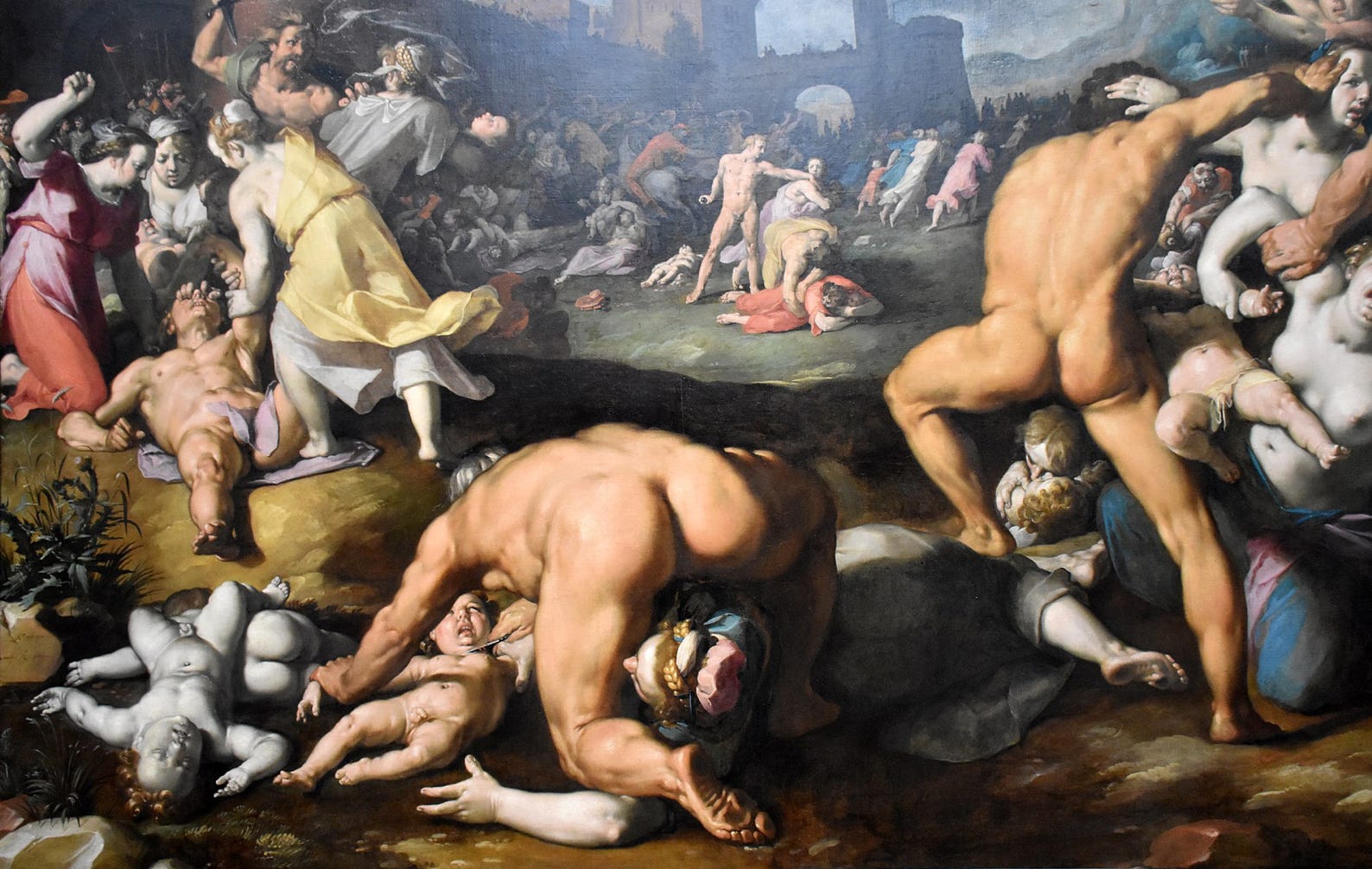
What is evil?

What is evil?
It’s taken me days to write this. I’m not sure that the 1,100 words which follow will be worth the wait. I skipped a Substack week, which is not like me at all. I kept circling the subject. I have been feeling oddly mute. I couldn’t find a way to talk about evil that was both socially acceptable and felt authentic to me. So, finally, I’m choosing authentic. And to hell — pardon the pun — with socially acceptable.
Is the world getting worse? Or is the worst simply more visible?
Take the Epstein files. The successive releases of emails and documents feel like slowly lifting a very large rock. Beneath the rock lie all the rotten, filthy, decaying, crawling things you could imagine.
Some of what we know is not speculation, such as trafficking, abuse and a network of powerful men. A shield of money, status and influence enabled exploitation. Victims have been dismissed, disbelieved and paid off. People determined to profit from misery and hardship can be found at the highest levels of government and business. The most serious moral matters are debated among men of power with a puerile, lascivious greed — and an accompanying lack of punctuation.
Then there is the murkier territory, and some long dark rabbit holes. Pizza and grape soda must be coded language. Epstein and his urologist were not 6 year old boys planning a treat, they were middle-aged men with depraved tastes. What the code means is a mystery, but the sheer volume of pizza references (one email just says ‘pizza’) suggests something dark and unsettling. And then there’s the jerky. You can see why people are suspicious — is it turkey, beef or baby? — because the material invites suspicion.
Maybe the response to the Epstein files mirrors past moral panics, like the Salem Witch Trials or the Satanic Panic of the 80s. People have always been capable of hysterically imagining horrors. But people have also always been capable of committing them.
The easier response is to put the rock down. To look away — nothing to see here! To mock — oh it’s just the normal gross solicitation of prostitutes and power, big deal! Curiosity itself becomes uncomfortable and taboo. Who knows. Who wants to know.
Whatever Jeffrey Epstein did or did not do beyond the proven crimes, he did evil things. That much is beyond dispute. And evil is not rare. People rape, torture and murder. Children and babies suffer at the hands of adults every day. People do knowingly profit from illness and poverty. Perhaps it is more comforting for some to imagine these crimes belong within the billionaires’ circles, as though only the elite commit special kinds of depravity.
But maybe they do? Something feels very off. Perhaps it is evil.
The truth is that these scandals in the elite reflect broader patterns in society’s moral landscape.
Our underwhelming political milieu pay lip service to Epstein’s victims, and yet this is to a British audience which is in thrall to online porn. One survey found that over 80% of men use online pornography, over one third use it in public and over a quarter would be unable to ‘quit’ for 90 days. Visit a mainstream porn website and you are met with a cornucopia of bondage, niche paraphilias and AI-generated fantasies, porn designed to convey incestuous desires while just circumventing illegality, and teens, babysitters and schoolgirls (all assuredly 18+ but not necessarily looking like it). The most popular pornography websites in the world are rearranging psychosexual boundaries and promoting ever more extreme content.
Remember that when politicians express sympathy for Epstein’s victims, perhaps 80% of them are regularly exposed to ‘barely legal’ porn and much worse.
Abominable new and proposed laws detach morality from biology in the name of ‘freedom’. Just here in the UK, think of assisted dying, decriminalisation of abortion to full term for the mothers, and puberty blocker trials. The continual gaslighting of the public feels dark too. And our culture is awash with spectacles that celebrate moral transgressions while calling them ‘art’ or progress. Something feels very badly off. Or evil.
Which brings me back to the question.
What is evil?
Evil could be defined as an extreme violation of moral boundaries, severe cruelty, or the denial of another’s humanity. But those definitions feel incomplete. Evil is not just behaviour. It is a condition.
Religious traditions frame evil as a corruption of the good. A distortion, something parasitic or an independent force.
But evil does not live safely outside us. It runs through human nature.
Can you recognise evil without recognising God? I’m not sure. You can construct moral systems and debate ethics, but if you remove God, look how much becomes negotiable.
Part of my hesitation in writing this is that it risks sounding irrational, even hysterical. I have spent years putting forward a combination of artistic positions and grounded, evidence-based positions. I stayed away from the spiritual and religious.
I was on safe ground when I asserted that it was unacceptable for the UK government to weaponise fear during a pandemic. I never indulged myself headfirst down any rabbit holes. Much to some readers’ chagrin, I did not make assumptions or assertions I couldn’t prove or directly quote. In essence, I did not chase conspiracies and I did not cite evil. Material reality was bad enough and spoke for itself.
But the weaponisation of fear did feel morally wrong even if some people involved had supposedly decent intentions.
During and since the Covid-19 pandemic I have sensed something beneath politics and culture — a struggle that feels moral, even spiritual.
I don’t claim to understand how evil works. I only recognise its texture.
The conclusion of Free Your Mind was simple. Stand for something or you will fall for anything. There are many ways to interpret that and my co-author and I offered multiple suggestions. In truth, I think the only truly stable foundation is faith.
We are living through an age of unveiling. Institutions losing credibility, secret power systems revealed, illusions dissolving. Many people desperately want the curtain pulled shut again. They want the rock put back down. But there is no point pretending you did not see what you saw.
In this time of unveiling, there are also lights to guide us. The actor James Van Der Beek recently shared a poignantly reflective video online before he died. In it he reflects on his identity as an actor, husband and father. But as he faced death, he said he recognised the most important thing, that he is worthy of God’s love.
‘I am worthy of God’s love.’
His video has been viewed many millions of times and is very moving.
There are endless rumours about Epstein. One conspiracy theory has it that he is alive in Israel. Dead or alive, he will face, or has faced, the same end and reckoning we all do. Perhaps he too pondered his identity and wondered whether he was worthy of God’s love.
I don’t believe in guilt by association. But I struggle to sympathise with those who remained close to Epstein. Those who travelled, visited, socialised and sought to benefit from his toxic beneficence are revealed now to be lacking in correct moral judgement — they made a putrid Faustian bargain of a ‘friendship’. Moral judgement is unfashionable, but sometimes judgement is simply clarity.
Did Epstein hold compromat over important people? This is another mystery — for now. But the answer to this dilemma is quite simple really: don’t do evil things, don’t enable evil things and don’t look away from evil things.
More than that, do good things, enable good, turn to good and talk about good.
We are fortunate enough to still just about live off the inheritance of a Christian civilisation and its uniquely moral architecture. But you cannot expect to endlessly harvest fruit from a tree whose roots you neglect. The tree is no longer healthy.
Evil, whether we like the word or not, is not going away. We all end the same way. Instead of waiting for the end, perhaps the better question — asked daily, hourly — is simple:
Am I worthy?


Fulton Sheen on the difference between a bad man and an evil man/person
“A bad man steals, a bad man kills. An evil man does none of those things but he seeks to destroy goodness in others - like corrupting youth and circulating all manner of evil pamphlets to destroy both faith and morals…”
Hannah Arendt said "most evil is done by people who never make up their minds to be good or evil".
Her 'Banality of Evil' was the observation that for many people thoughtlessness lay behind participation in evil, a failure or incapacity to consider human consequences.
Arendt said "most evil" for not all evil is banal. The glee shown by Palestinians as they murdered Jews on 7th October 2023 with acts of utter depravity and savagery was not banal anymore than was the depravity behind the so called "grooming gangs". It was not thoughlessness but a religious belief that the kuffar girls were less than fully human.
Evil comes in many forms. Making up our minds to be good matters.