The sniff test
What we can learn about human psychology from pet dogs
You can learn an awful lot about human psychology by walking your dog. It’s where human and canine instincts collide in a daily tangle of projection and foibles.
Take my oldest dog. She’s a mongrel with a keen nose for the weird and the wonderful, and she has always been a little… finely tuned. Given I’m about to tell you that you can learn a lot about an owner from a dog, I should stress that this is not always the case. My dogs’ good qualities are obviously down to me, or at least the fruits of my training, but any bad habits are clearly genetic or beyond my control. That’s my story and I’m sticking to it.
As a puppy, she barked at lone carrier bags on the ground, as though they might leap up and attack. She’s a throwback to a more superstitious age and still barks at planes as if the gods are displeased. Fireworks send her spiralling. Horses used to terrify her but we’ve worked on that. Unfortunately, her suspicion of German Shepherds is stubbornly persistent. She also barks at men with pushchairs, but not women, and she has a very particular dislike of a certain sort of person. It’s taken me years to decipher the pattern but I can now predict, with eerie accuracy, the type she’ll take against: high-vis gloves or other eccentric garb and, most reliably of all, that indefinable sense of ‘doesn’t quite belong in the countryside’.
Obviously I do the responsible dog-owner thing: distracting her with treats, steering her away, muttering ‘sorry, she’s friendly, just barks when she’s nervous’. But the truth is I’ve come to trust her judgement. Some of it is simple neophobia — dogs are biologically programmed to treat anything unfamiliar as a potential threat — but some of it feels like good instinct. Every now and then I look at a man she’s bristling at and think, well, I do believe you’re not entirely wrong there.
The thing is, dogs form attachment styles that look remarkably like human ones. A securely attached dog explores with confidence, checks in with its person and copes well with brief separations. That says something about the owner. Secure attachment doesn’t materialise out of thin air. It comes from consistency, warmth, predictable responses and a human who isn’t leaking their own stress like a poorly sealed kettle. There’s even evidence that dogs and their humans engage in a kind of emotional mirroring, possibly involving mirror neurons, those curious little cells that fire both when you act and when you observe. Spend enough time with a creature and you begin to reflect each other, for better or worse.
Which brings me to the dog owners who have unwittingly trained an operatic level of anxiety into their pets. I meet more of them than ever. This week my dogs and I were strolling along happily when a woman ahead froze, shrank into the hedge and yanked her dog towards her. ‘He’s not friendly, he’s not friendly!’ she cried, palm outstretched like an zealous traffic officer. The dog looked perfectly pleasant. She did not. It doesn’t take a psychologist or animal behaviourist to work out what’s going on there.
Covid changed people. Walkers eyed each other with suspicion. There was even, briefly, a nonsense rumour that dogs and cats were vectors of disease. At the same time, hordes of people who had never previously darkened a footpath emerged for their daily sanctioned hour, cluttering up the countryside with their paranoid jumpiness. Whatever was hanging in the air then – and I don’t mean the airborne virus – is still drifting about now. There are so many more anxious walkers eager to warn you about this foible or that quirk. When did dogs become so fragile and complex?
Partly because the people aren’t the same, and partly because the dogs aren’t either. The strange global social experiment known as lockdown produced a generation of so-called ‘pandemic puppies’. Many were raised during the crucial socialisation window when the world is meant to be a kaleidoscope of friendly strangers and varied environments. Instead they got four walls, a garden and the same old faces on repeat. The result is a cohort of dogs that are, unsurprisingly, more fearful, more reactive and more baffled by other dogs. Their owners, many of them first-timers, had limited access to training and socialisation which rarely ends well. A dog born into scarcity of experience will behave like a creature short on reference points.
Then there are the encounters that go beyond social awkwardness. My dog seems to detect when someone has a mental-health difficulty that might make them unpredictable. She stiffens, watches, sometimes growls. It’s unfortunate because those people don’t need an over-alert dog adding to their challenges. Just as dogs can smell certain diseases, I sometimes wonder whether they can smell psychological distress too. A literal sniff test, if you like.

Of course some dogs are magnificently trained. I met a chap recently, ex-army, who owns three Belgian Shepherds. I bet they patrol at heel like a crack regiment. I said I assumed they must be impeccably trained. ‘They are,’ he confirmed. ‘Mine, not so much,’ I admitted. ‘That tends to say a lot about the owner,’ he said. Hmmm.
It’s true, you can tell a surprising amount about a person from their dog. Sometimes it’s the behaviour, sometimes the training, and sometimes it’s simply the name. And few things reveal a dog owner quite like the name they shout across a field.
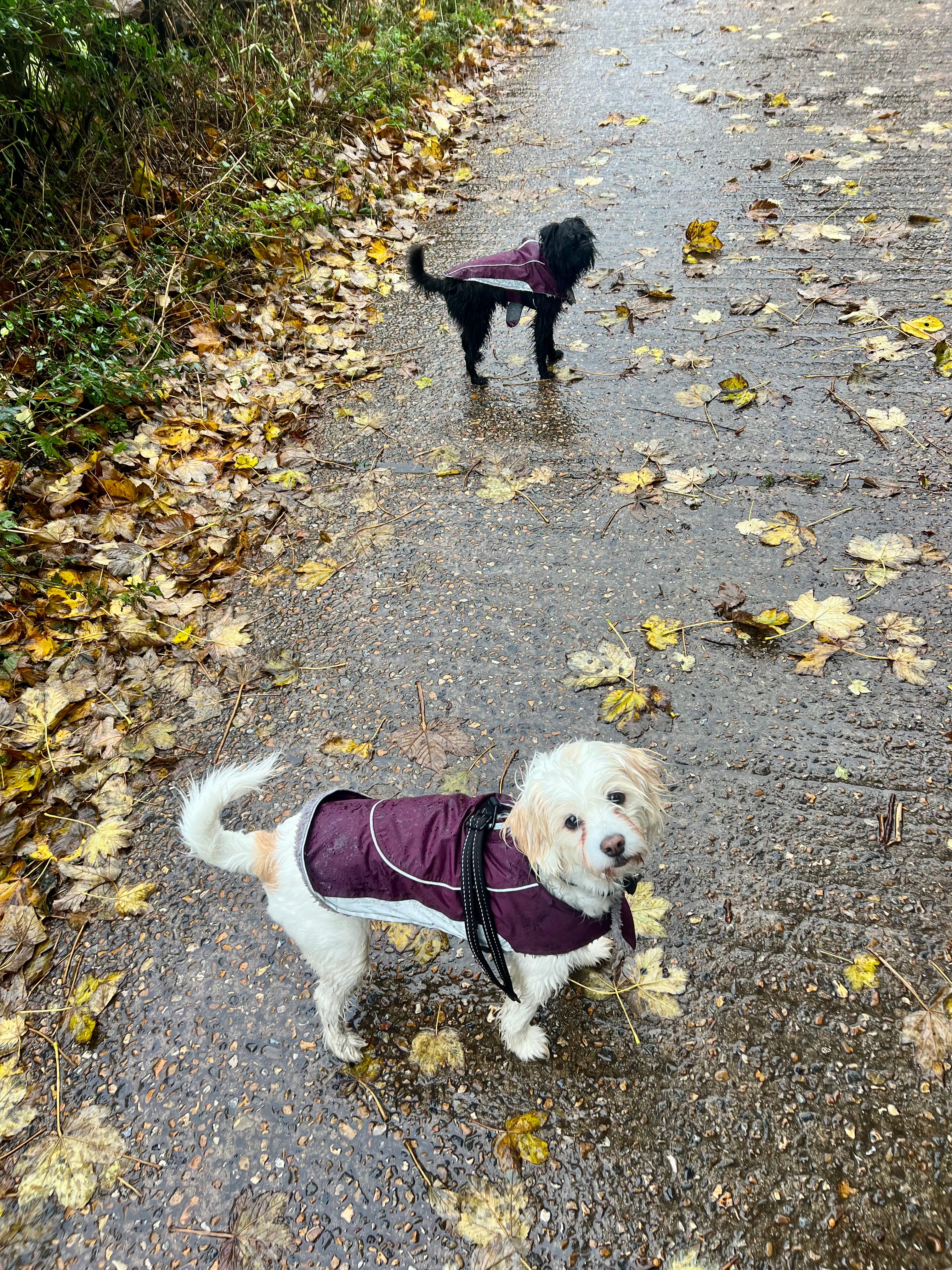
My husband’s normally booming baritone takes on a slightly sheepish timbre whenever he calls our newest puppy on a walk. Well, that’s what you get for giving a tiny dog the Latin name ‘Corvus’. He can’t complain now that shouting it across a muddy field makes him sound like an embarrassed Roman general. Still, as a cross between a black crow, a monkey and a mop head, the name fits. ‘Gremlin’ would also have been accurate.
And as we edge towards Christmas, the dog jumpers appear. Nothing divides dog owners quite like clothing. On one side, the naturists, who believe a dog should be dressed in fur alone. On the other, the outfitters, swaddling darling fashion victims in knitted reindeer. Halloween outfits were a thing this year! I reserve judgement, although the dogs themselves often look as though they’d very much like to speak to someone in authority. Little Corvus is actually very clever given his brain can’t be any bigger than a walnut — he’s worked out how to take off Luna’s rain coat with his teeth.
Still, whatever our quirks, if you like dogs or are owned by one, you’re probably a decent human. Cat owners? The least said the better.


Lovely!
I am a dog owner and I agree!
As for your comment about cats, well........I would agree as well! :)
I have to say that I can identify with your old dog. I do have extreme separation anxiety when my wife leaves, but other than that I am well behaved...mostly. Thank you.
Lebo Von Lo~Debar
Former/Always 82nd Airborne Infantryman, Disabled Veteran for Life, & Author of the book, "The Separation of Corporation and State" subtitled "Common Sense and the Two-Party Crisis" Available on Amazon.
https://a.co/d/fy5rSdW