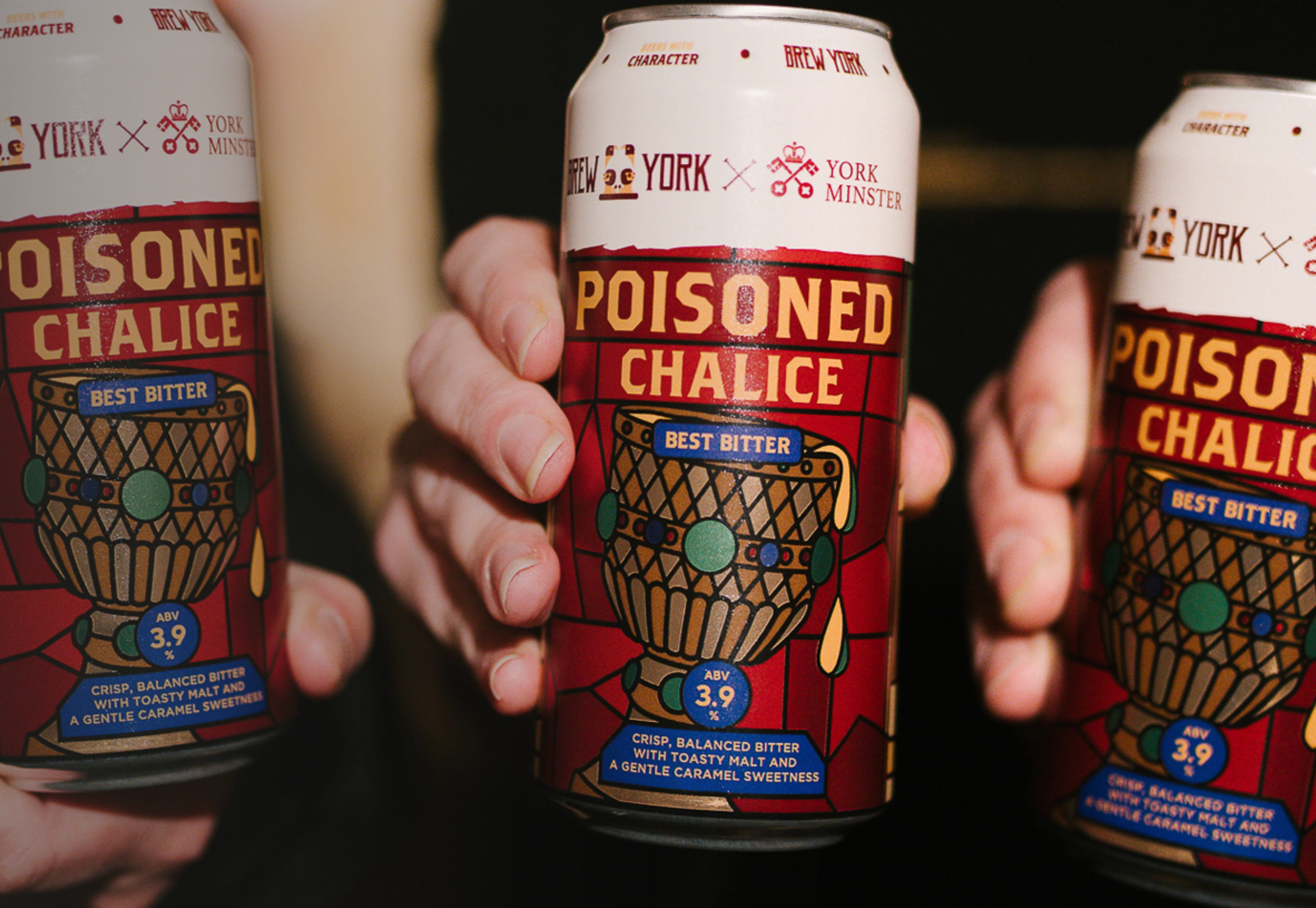
The Poisoned Chalice: York Minster's Bitter Brew

There is a moment in every institution’s decline when the desperation becomes visible. York Minster has just had one of those moments. The Minster has partnered with local brewery Brew York to produce a beer called Poisoned Chalice, supposedly to mark the 800th anniversary of the canonisation of St William of York. The reaction has been, depending on your tolerance for institutional self-abasement, either rather funny or genuinely troubling. Probably both.
Let me first deal with the obvious deflection. Yes, monks have brewed beer for centuries — the tradition stretches back to medieval times, when monks brewed because water was dangerous and pilgrims needed sustenance. But monks made their beer. They didn’t lend their brand to a commercial brewery in exchange for exposure. The monastic brewing tradition is one of self-sufficiency, sacred labour and hospitality. York Minster’s PR partnership feels more tawdry.
Dr Gavin Ashenden, once chaplain to Elizabeth II and now a Catholic, put it plainly in The Telegraph: “It happens to be York Minster and beer this time — but the pattern is familiar, in which an ailing organisation seeks to entertain and enter into a kind of usefully symbiotic partnership with someone else.” Ashenden called beer “a drug” and suggested the Church is being “insensitive, careless” in its judgment, given the sustained rise in alcohol-related deaths since Covid. This may not be a popular position, but it is not an unreasonable one.
In England in 2023, 8,274 people died from causes wholly attributable to alcohol — a rise of 42.2% since 2019. And it is worth noting that Yorkshire and The Humber is the region with the highest number of alcohol-related deaths in the country, having seen a 43.77% increase over the last five years, as well as the greatest increase in drug use. York Minster stands in Yorkshire.
The Church of England seems to be shutting its ears to this tragedy — which is a pattern, is it not? It also shut its doors during lockdown. Arguably, the Church failed its congregations then, and it is failing them now with this obtuse cheerfulness about beer.
One wonders where the logic ends. The Bible contains plenty of material that the Church of England has not yet monetised. The Song of Solomon is bracingly physical about breasts and desire — “Your two breasts are like two fawns, twins of a gazelle, that graze among the lilies.” — so perhaps the Minster could partner with a tabloid to bring back Page 3 under ecclesiastical branding? And there is plenty of casting of lots to make decisions in the Bible. A Church of England and Bet365 joint venture cannot be far off — Take a Gamble on the Resurrection!
Perhaps all this could be seen as clumsy, well-meaning outreach if it weren’t for one rather important detail — the beer is called Poisoned Chalice. St William of York — a twelfth-century archbishop who became the city’s patron saint — is thought to have died after drinking from a poisoned chalice while celebrating Mass at the Minster. He believed he was drinking from a blessed sacrament. His death was, by any measure, a martyrdom steeped in the symbolism of the Eucharist. And the Church of England’s response to his 800th anniversary is to name a beer after the murder weapon.
They could have called it Holy Grail Ale, or Heavenly Hops, or Saint’s Rest, or any number of names that honoured a holy man without making a punchline of his death and the Eucharist. The marketing department has not apparently considered that the chalice at Mass is supposed to contain the symbolic blood of Christ — or, for Catholics who believe in transubstantiation, literally does. (Perhaps part of the problem is that there is a marketing department.)
It also recalls something darker in contemporary culture. There is a recurring aesthetic — think Marina Abramović’s spirit cooking, the Lady Gaga tableau with fake blood and a human-shaped cake, or Neil Patrick Harris’s ghoulish Amy Winehouse corpse cake — that ties ritualised consumption to death. I am not suggesting the Dean of York is in league with performance artists who bathe in synthetic gore, but there is something disquieting about the Eucharist — the most sacred act of Christian worship — being turned into a joke about poisoned drinks on a can sold in a gift shop.
The Rev Marcus Walker, founder of the Save the Parish campaign, called the beer “a brilliant idea” that reminds people “the Church of England isn’t a religion for Puritans.” Too true, Christianity has never been Puritanism, and wine certainly features rather prominently in the New Testament. But there is a considerable distance between the Wedding at Cana and slapping your name on a bitter named after a martyr’s death in order to “reach beyond the usual audiences,” as the Dean put it. What does he think will happen? That a twenty-five-year-old, mid-pint of Poisoned Chalice, will set down his glass and begin meditating on his spiritual journey?
The Church of England is clearly struggling. Attendance is falling, and the temptation to do anything that might catch the attention of people who wouldn’t normally darken a church door is strong. But is desperation producing decisions that are beneath the dignity of the institution making them?
St William deserved better. So do the people of Yorkshire, 877 of whom died from alcohol-related causes in recent years — the highest toll of any English region. The Church might consider attending to that fact before it raises another glass.


York, as a Labour run city, also has a plethora of social and financial problems. There are areas of great social and financial deprivation which the lovely folk at the minster will be oblivious to, given how much it now costs to enter those hallowed portals as a mere visitor (£20 for an adult last time I checked). If you go to a service, entry is free.
I agree, this is crass and ill thought out. Designed to garner publicity, and no doubt spark curiosity and conversation. But so disrespectful. Unfortunately, that's just what we've come to expect from our national faith, isn't it? They never fail to disappoint us.
Does the C of E expect to be taken seriously..?