

The Nudge Is Hotting Up

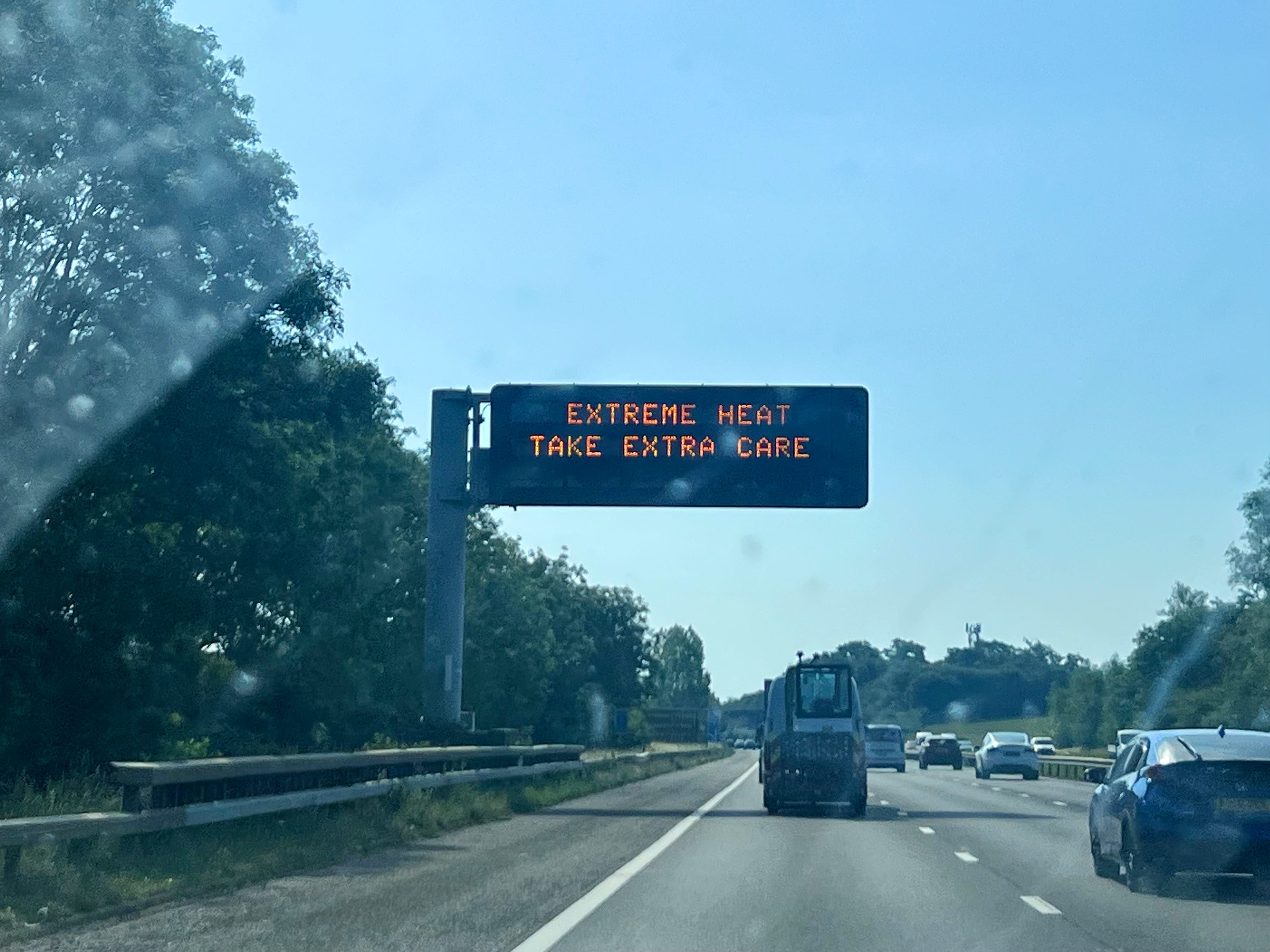
When we stepped out of the car on Wednesday at a service station outside Warwick, we expected to be hit by a nasal-singing wall of heat. We were met with a balmy warmth and an effective breeze. Only a snowflake would have had trouble with the weather on that particular tract of the motorway.
The motorway signs had repeatedly warned us about “Extreme Heat”. Perhaps that should have read “Extreme Cheat”?
I am not a climate denier, God forbid. I know we have climate. I know it’s changing. And I know we’re in a heatwave. It just wasn’t particularly hot that day. And I wasn’t quite sure what the warnings were implying. What sort of extra care? Stay off the motorway? Stay home? Drink (water) while driving?
The reason I think the signs really should have read “cheat” is that I am afraid what is really hotting up is the nudge.
Nudge is a concept from behavioural economics, in which the choice architecture of an environment is manipulated to steer people towards a desired behaviour. For the nudge to really work well it happens without their necessarily being aware of it. In principle, a nudge doesn’t forbid or compel, t simply makes one course of action feel like the obvious and reasonable response. There are many types of nudges and you can read Free Your Mind: The new world of manipulation and how to resist it among other books, if you want to know more.
During Covid, the UK government’s behavioural science unit SPI-B deployed it systematically: the motorway signs telling us to stay home, the social distancing stickers in supermarket aisles, the daily death counters on the news. The messaging wasn’t primarily informational, it was motivational.
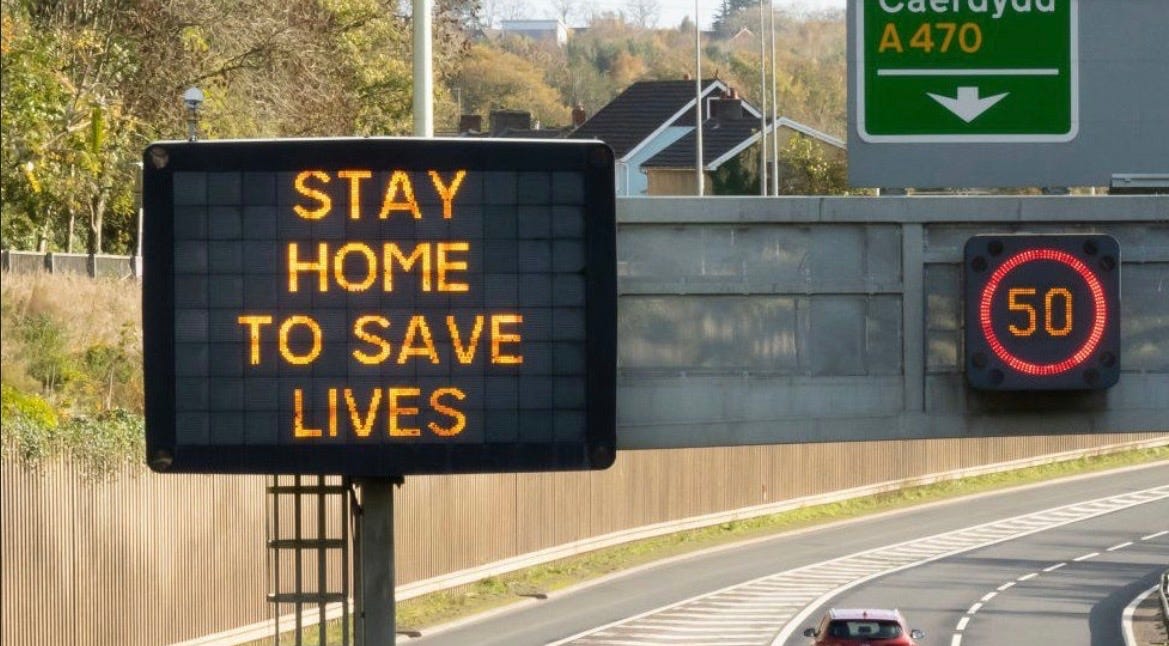
And you cannot miss the same playbook as Covid now, even down to the motorway signs. Those signs were one of the last lingering symptoms of a state which sought to interfere in every aspect of our lives during the pandemic.
You are likely to be aware that the extent of man-made climate change is contested. No, the science is not settled — that phrase is itself a rhetorical nudge. And the impact of proposed net-zero changes is also hotly contested.
But June 2026 has indeed been notably warm. However, notable is not the same as unprecedented in Earth’s long history of climate variability. And exceptional weather is not self-evidently proof certain catastrophe.
I wrote at length in A State of Fear: How the UK government weaponised fear during the Covid-19 pandemic about the systematic deployment of fear by the British government during Covid-19. The pandemic became a laboratory for social scientists and behaviouralists: how much could you modify public behaviour through messaging, social pressure, and the engineering of anxiety? The answer, it turned out, was rather a lot.
“The idea of going back to so-called-normal is a major area of consideration. There’s a climate crisis coming and that’s going to have to be dealt with. The way we have gone about adapting to the virus has been quite beneficial in terms of working patterns and reducing carbon – all the things we are going to have to go through to adjust to the new future. As the New Zealand prime minister put it, we need to ‘build back better’. There are challenging times ahead of us for the next 20 or 30 years, God help us. The most major crisis of humanity is starting. I see the weather patterns changing around me. I believe in climate change. It’s already getting bad. These will have major impacts on the nature of the world around us.”
My blood had chilled. I had not asked Clifford Stott, Professor of Social Psychology and SPI-B member about climate change. I had asked him how the social scientists had planned to help the population to climb down from fear and return towards normality.
I hadn’t imagined that a SPI-B advisor would segue from how to end lockdown to the next major project requiring population compliance. But Stott was far from alone. Speaker Lindsay Hoyle put it rather more baldly at the G7 Speakers’ Meeting: “What surprised many of us in the UK was how engaged most of the population became once the seriousness of the situation was made clear. People were prepared to accept limitations on personal choice and lifestyle… No one could ever imagine that we would be wearing masks so readily and that we would all be so compliant.”
I was asked to write the climate equivalent of A State of Fear. I gathered a dossier of nudges for many months. Reader, I didn’t have enough stomach left. But it seems some of the tactics are hotting up — so to speak — and the moment demands revisiting.
Let us go through it.
My stepdaughter’s Duke of Edinburgh expedition has been cancelled. The dangers of heat could have been mitigated by the fact that the participants are young, fit, and they could have taken extra stops to rehydrate along the way. Being in a tent in a heatwave would have been unpleasant, but it would probably not have been dangerous for this cohort. Unpleasant should not be grounds for cancellation. The dangers have perhaps been exaggerated. I don’t suggest there is a deliberate intention on the part of the teachers of Duke of Edinburgh scheme to crank up climate anxiety, it’s just that our safetyist culture is now primed to climate anxiety.
You see, this is merely the tip of the melting iceberg. While school kids are being told not to camping, there are much more significant proposals.
There are calls to introduce maximum workplace temperatures. The National Education Union has said that a maximum indoor working temperature of 26°C is appropriate for schools, and the Climate Change Committee has called for a “national maximum temperature” for workplaces. There is, as yet, no legal upper limit. But the campaign is underway.
Hospitality businesses across the UK have closed or adjusted their opening hours as a result of what the Met Office calls “uncomfortably hot” working conditions — and that is entirely their prerogative. But the calls for legislation are intensifying. Bakeries and cafés have shuttered or reduced their hours and menus this week, including Greggs. A popular pub closed during the heatwave after temperatures behind the bar reached more than 34°C. Separately, France banned public alcohol consumption in “red alert” zones, ordered 845 schools to close, and cancelled trains, concerts and sporting events as temperatures reached 40°C in some areas.
Then there are the schools. A handful of schools in the west of England confirmed to the BBC they’d be finishing lessons early as a result of the heat. Calls are growing for closures to become policy.
I wonder, would the same public health professionals calling for school closures in southern England also advocate ending all education south of Rome? Or indeed for the whole of sub-Saharan Africa? Or does this logic apply only to people who have become accustomed to operating within a very narrow thermal band?
And if schools don’t close, can you refuse to send your delicate darlings? And in a classic example of no-news propaganda, the BBC asked readers: “Can you refuse to work or send your kids to school during a heatwave?” This is a headline that does the nudging work merely by posing the question.
The economy and education are from recovered after the lockdowns of 2020-2021. It is astonishing that some people want to shut up shop and school all over again.
And on one hand, we are not supposed to work without air conditioning. On the other, we mustn’t install it at home. You cannot win.
The Met Office social media account has been in a state of barely suppressed horrified rapture this week. A deluge of warnings, red maps, and alarming statistics has poured forth. The maps are a deepening gradient of red — they are going to run out of a sufficiently crimson pigment at this rate.
A torrent of Met Office tweets ask “What’s the difference between an Extreme Heat Warning and a Heat Health Alert?” and “An exceptional spell of hot and humid weather is expected across this region, with impacts to the general population highly likely”. Just as Covid was falsely presented as risky for the entire population rather than discrete vulnerable groups, weather is now being positioned as dangerous for everyone, when it is not.
And none of this hysteria is matched in the winter when cold-related deaths vastly outnumber heat-related deaths. One kind of temperature death merits red maps and emergency legislation. The other merits embarrassed silence and prim instructions to turn the thermostat down for the climate emergency.
All this reminds me of another SPI-B advisor who told me anonymously that “Psychology has had a really good epidemic, actually.” The same person, also a psychologist, confessed that “psychologists tend to be more on the neurotic end of the spectrum.” I suspect that the staff at the Met Office are not immune to a similar occupational enthusiasm.
If you think this kind of journalism matters — the kind that notices what is being done to you — consider becoming a paid subscriber. It’s what makes The Free Mind possible.
