

The Keeper of the Key and other inconvenient truths about Israel
Apartheid, Genocide, Colonialism: A fact-check from Israel

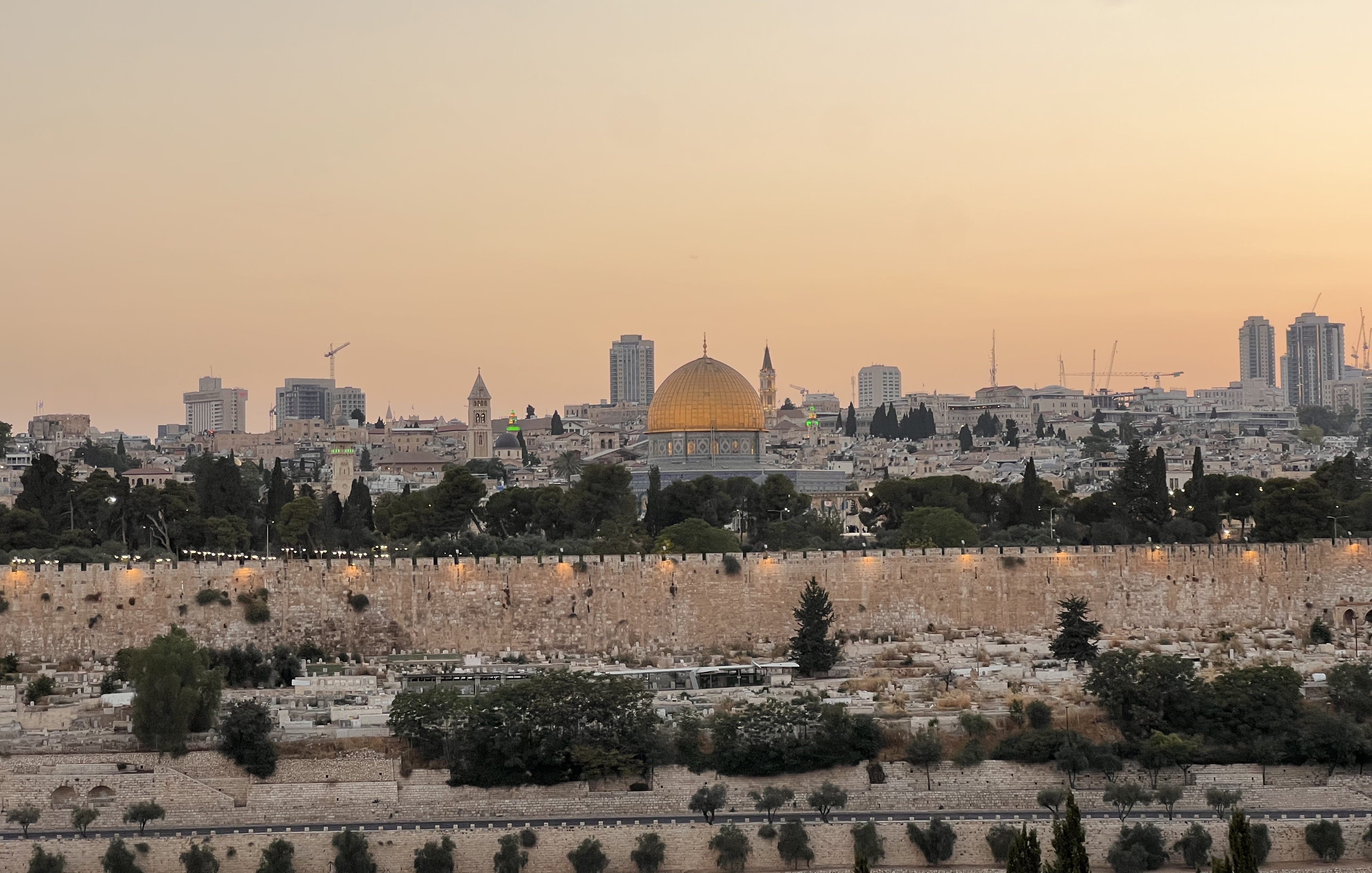
On the first evening of our trip to Israel, we stood on one of the hills surrounding Jerusalem and watched the sun set, lighting up the iconic golden dome. We took in the view as the Muslim call to prayer sounded from minarets across the city.
The Dome of the Rock is a glittering paradox. It is the beautiful landmark you inevitably associate with Jerusalem, but it is not Jewish. In fact, it is part of the Muslim Al-Aqsa compound, also known as the Noble Sanctuary, and it is the third holiest site in Islam. The dome is a shrine, not a mosque, and it sits atop the Noble Rock, from which Muslims believe Mohammed ascended into heaven.
To compound the contradiction, this is also the site of the Temple Mount, where the Jews’ First and Second Temples stood. Jews believe the rock is the Foundation Stone of the world. Inside the original temples would have been the inner sanctum they called the Holy of Holies, where the Ark of the Covenant was kept. Christian and Jewish tradition has it that this rock is where Abraham nearly sacrificed his son Isaac to prove his faith in God.
So the holiest place in the world for Jews is now a Muslim site of worship and, although Jews may legally visit, they may not pray. However, the Chief Rabbinate of Israel forbid Jews from visiting the Temple Mount because of ancient laws about purity rituals.
Despite all this, Jews, Muslims and Christians live alongside each other in Israel. There are synagogues, mosques and churches throughout the city. As the meeting point for three major world religions, no wonder Jerusalem is a ‘thin place’, as I said in my first essay about Israel.
And yet critics call Israel an ‘apartheid state’.
I’ll come back to that later in this essay, but first, more from personal experience of meeting people of different faiths.
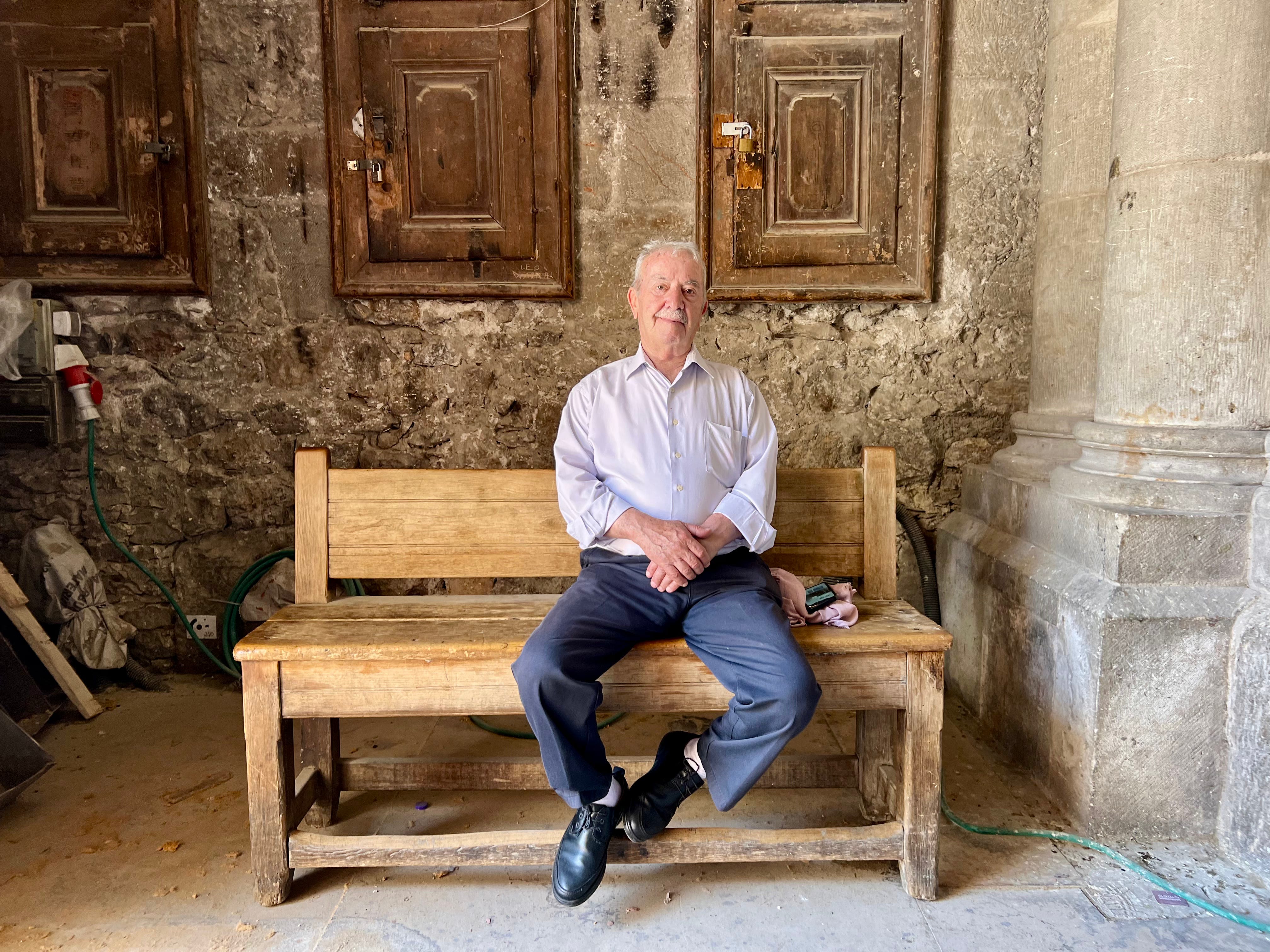
The first person I talked to, outside of hotel staff, was a man called Wajeeh Nuseibeh. I had arrived in Jerusalem some hours before the rest of the delegation and decided to pay a visit to the Church of the Holy Sepulchre alone. At the end of a leisurely amble through the labyrinthine complex, I sat on a bench by the main door to watch the comings and goings. Wajeeh struck up conversation with me.
It turned out he was the Keeper Of The Key to the Church of the Holy Sepulchre. I drank in the exotic ‘job title’ and his fascinating anecdotes. Apparently, two Muslim families act as neutral overseers of the site, to prevent the different Christian denominations from falling out with each other. This unlikely arrangement dates back to the Muslim conqueror Saladin in the 1100s.
He was keen to share information about the church, and to show me his photographs of famous visitors. He was a mine of interesting conversation, right up until he ruined it by entreating me to visit his family’s shop round the corner, for a 50% discount, a cup of tea, and permission to use the bathroom.
Still, the Dome of the Rock, the call to prayer sounding through the city, and the ever-present Muslim Keeper of the Key brought home the obvious — Israel is not an apartheid state.
(As I mentioned the hotel staff before, I should also point out they were Muslim, Christian and Jew. That’s right, people of three religions and different ethnicities in one place of work.)
I knew this already. I expect you, my readers, know it too. But the claim is repeated over and over, as though sheer stubborn frequency will eventually make it true. And this is how it works: thanks to the Illusory Truth Effect, whereby repetition increases perceived truth, even the most sensible and balanced of people will begin to believe lies eventually.
So I thought I would use this essay to dispel a few of the myths about Israel, or at least to bring a little nuance. I liked the country more than I imagined I would from my brief visit. And it made me wonder more than ever: why is Israel losing the ‘PR war’?
I do not claim that one week in Israel, courtesy of the Combat Antisemitism Movement, makes me an expert. But what I saw firsthand, combined with easily available facts, should be enough to debunk some of the shibboleths of the pro-Palestinian movement.
Apartheid
I think I have already made the point that Jewish and Arab citizens live, work and worship alongside each other. Yet the claim that Israel is an apartheid state persists, including among organisations with serious standing. Amnesty, for instance, published “Israel’s Apartheid Against Palestinians: Cruel System of Domination and Crime Against Humanity” and runs a free ninety-minute course called “Deconstructing Israel’s Apartheid Against Palestinians”.
Coming from Amnesty, I would once have taken that quite seriously. Of course, I used to take the famous human rights charity itself quite seriously and donated every month for years. But the organisation’s values and mine have diverged considerably of late. Only last month it released a report, “A growing threat: the anti-rights movement in the UK”, which named the All-Party Parliamentary Group Christians in Parliament, and a raft of ordinary Christian groups, as “anti-rights”. The mind boggles.
It isn’t just Amnesty, though. It’s newspaper and dinner-party fodder the world over. So, is it true that Israel is an apartheid state?
Properly understood, apartheid is an institutionalised regime of systematic oppression by one racial group over another, built and maintained expressly to preserve that domination. Whatever you want to call Israel’s messy situation and argumentative, multi-ethnic democracy, it bears no resemblance to that.
Arab citizens vote in the same elections as Jewish citizens. They sit in the Knesset. They have served in government and on the Supreme Court. They work as doctors, nurses, judges and academics, alongside every other profession you could name. Arabic writing is on road signs and banknotes.
Here are a few examples of what integration in Israel actually looks like:
In 2022, Khaled Kabub was sworn in as the Israeli Supreme Court’s first Muslim justice.
The Islamist Ra’am party became the first independent Arab party to join an Israeli governing coalition.
Arab representation among physicians has risen from roughly 8% in 2010 to 25% in 2023.
Druze citizens serve under compulsory conscription alongside Jewish Israelis, while other Arab citizens — Muslim, Christian, Bedouin — serve voluntarily in the IDF, including in combat roles.
There are, on the other hand, no civilian Jews living in Gaza at all. Under the 2005 Disengagement Plan, Israel evacuated every Israeli community in the Gaza Strip and withdrew its permanent military presence, along with four communities in the northern West Bank.
Genocide
It is only fair to insert into this piece, that a trip organised by the Combat Antisemitism Movement was designed to improve Israel’s standing in our eyes. And yet I still saw what I saw.
One of the things I saw was a resolute commitment to life. This showed up in so many ways. We visited the genuinely heart-warming charity Save a Child’s Heart, which has treated more than 3,000 children from Gaza and the West Bank. If Israel were bent on genocide, you would think it might stop mending Palestinian children’s hearts.
The genocide charge is among the gravest that can be levelled against any state, and it is one of the cruellest inversions in Jewish history. Genocide was defined as a crime in the aftermath of the Holocaust. Now that same accusation has been turned against the Jewish state.
The inversion is especially grotesque given that Israel entered this war in self-defence, after Hamas perpetrated the deadliest massacre of Jews since the Holocaust. I have watched the Bearing Witness film which includes horrific video footage of the worst terrorist attack of our lives. It is pure barbarism, and much of it comes from the terrorist’s own bodycams. It did not come out of nowhere: Hamas's founding charter explicitly calls for Israel's elimination. On 7 October, Hamas put that ideology into practice. Weeks later, senior Hamas official Ghazi Hamad declared that Israel must be removed, and that Hamas would repeat 7 October “again and again”. And yet the genocide accusation lands not on the organisation openly committed to Israel’s destruction, but on the state refusing to let that destruction happen.
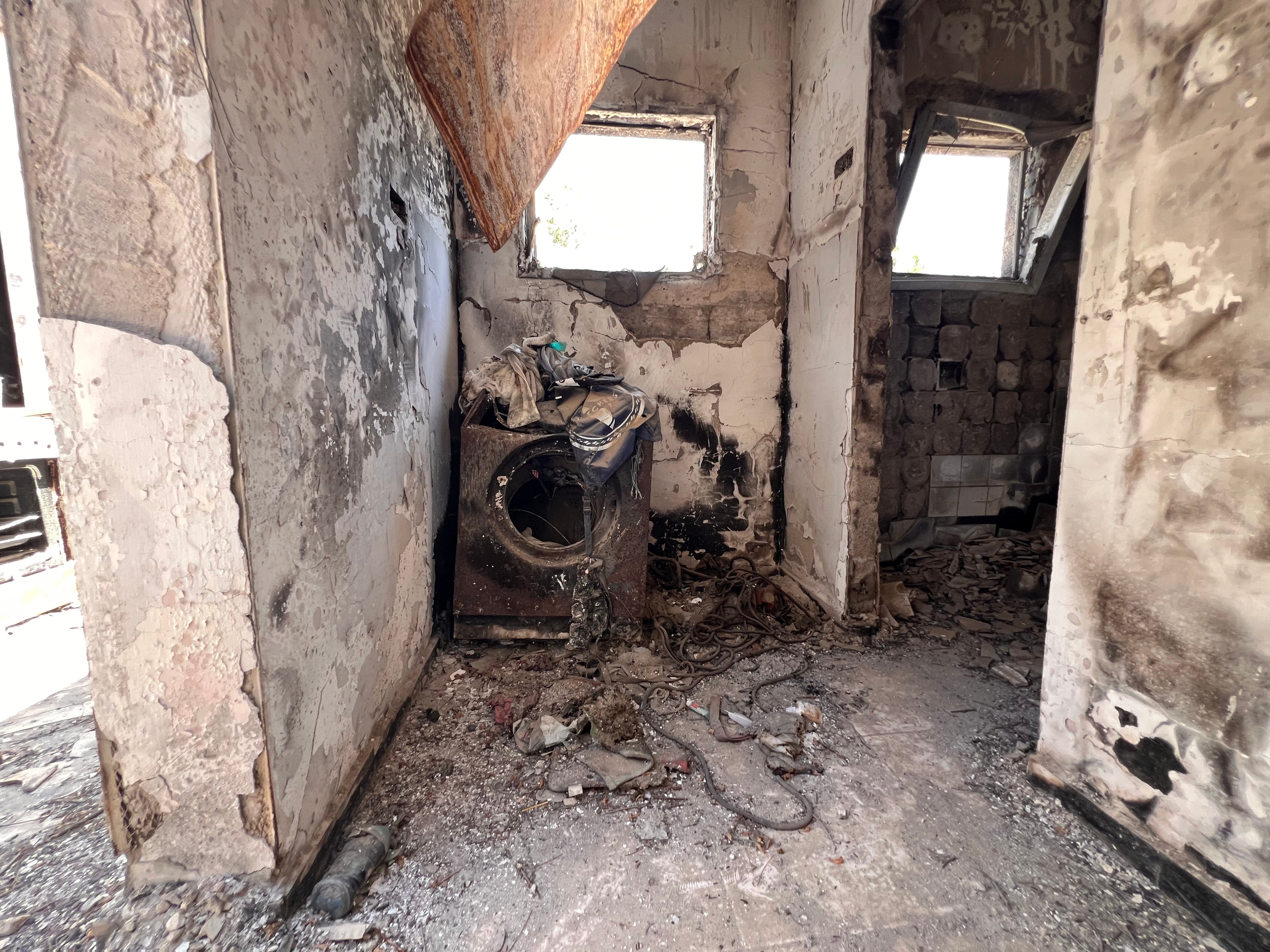
Israel entered the war with the declared aims of dismantling Hamas and bringing the hostages home — not of destroying the Palestinian people. The Genocide Convention requires proof of specific intent to destroy a protected group, as such. Civilian deaths and destruction, however grave, do not by themselves establish that intent.
Within the war itself, the IDF has repeatedly used multiple advance-warning methods to move civilians out of harm’s way: phone calls, text and voice messages, airdropped leaflets. By 31 March 2024, the IDF reported roughly 100,000 evacuation calls, 9.3 million leaflets, 15.5 million evacuation texts and 17 million recorded messages.
A dedicated Civilian Harm Mitigation Unit tracks civilian movements and evacuations in real time, drawing on intelligence and open-source information to help Israeli forces work out where civilians remain and avoid harming them during operations. Updated information is fed continuously to Israeli air, ground and naval forces.
If this is genocide, it is being conducted remarkably badly. While population growth cannot alone disprove genocide, the fact is that the Palestinian Central Bureau of Statistics puts Gaza’s population at 1.88 million in 2017 and 2.23 million in 2023 — an increase of roughly 19% in six years. There is certainly no long-term policy of physically destroying the Palestinian population.
(The International Court of Justice (ICJ) has not yet delivered a final judgment on whether Israel has committed genocide.)
Settler Violence
This is such a complex issue that I cannot claim to unpick it authoritatively here. But having done some research, I think it is considerably more nuanced than the media would have us believe.
There are a few strands worth separating out. First, there are genuine cases of settler violence directed at Israeli Arabs and Palestinians. Second, there are the high-profile cases reported in the media, which are rightly condemned, but I cannot be certain about the accuracy or context of every report. Third, there are the statistics — which are not always as reliable as you might expect.
The actual violence is driven by a small extremist minority, not by the broader Jewish population of Judea and Samaria. Israeli defence officials estimate around 300 Jewish extremists are involved in violent attacks, with roughly 70 forming the hardcore group responsible for the most serious violence. Israel’s own security agencies classify the gravest of these attacks as terrorism, and dozens of suspected extremists have been placed under restraining orders or house arrest. Many would argue, including within Israel, that this does not go far enough.
A recent high-profile case, also condemned by US Ambassador Mike Huckabee, was distressing and disturbing. For five nights, Israeli settlers surrounded three Palestinian homes on the outskirts of a town in the occupied West Bank, preventing the families from leaving safely as their food and water supplies dwindled.
But it is worth noting that Israeli security agencies publicly describe extremist Jewish violence as a serious criminal and security problem and have taken measures against some perpetrators. That it continues at all is a failing against innocent Arab Israelis and Palestinians, as well as against Israel’s own image.
Then there are the statistics. Anyone who has followed me since Covid will know how easily statistics can be manipulated to buttress a political position.
Take the United Nations’ report “Humanitarian Situation Update #352 – West Bank”. You’ll find it filed on the UN website under “The Question of Palestine” — perhaps the bias is right there in the section title? It states that in 2025 more than 830 Palestinians were injured by Israeli settlers in settler attacks — an average of two Palestinians injured per day. This is an extremely concerning picture. But let’s take a more detailed look at how this data is compiled.
The data comes from OCHA, the UN’s Office for the Coordination of Humanitarian Affairs, which itself acknowledges that its settler-violence database rests on assumptions. Its definition of “settler-related violence” is broader than settlers attacking Palestinians, also including intimidation and trespass, and its own methodology allows the perpetrator in an incident against Palestinians to be an Israeli settler, Israeli security forces intervening in a settler-related incident, or both.
Before I go further, I should also note that OCHA has repeatedly published Gaza casualty totals supplied by the Gaza Ministry of Health — in other words, the health arm of a proscribed terrorist organisation — while explicitly labelling them as figures provided by that source. But it has only added casualties from the post-7 October hostilities to its database once they have been verified by the UN. This appears to create a double standard, and there is an inherent difficulty in relying on casualty data supplied by an organisation controlled by terrorists.
And there was a major revision of the Gaza deaths breakdown in May 2024. OCHA’s earlier reporting gave approximately 9,500 women and 14,500 children among 34,735 reported Palestinian fatalities. Two days later, it reported that only 24,686 of those fatalities had actually been identified, with the identified women and children figures falling dramatically.
This is not to say OCHA is deliberately fabricating or inflating its statistics. But might there be a systemic bias at work? And what damage is done by figures which, once released, cannot be retracted from the minds of readers and viewers?
Regavim is a controversial organisation, dedicated to preventing the illegal seizure of state land and to restoring the Zionist vision. So while you should bear that in mind if you read their April 2025 report, “False Flags and Real Agendas “Settler Violence” - A Modern Blood Libel”, I would urge you to nonetheless read it. It analyses the OCHA database of 8,332 “incidents involving Israeli settlers and other Israeli civilians” recorded in the West Bank or Israel (not Gaza) between 11 January 2016 and 30 April 2023. (This is a separate figure to the 830 injured Palestinians cited above, but probably illustrative of the same quality of data.)
Regavim argues that the concept of ‘settler violence’ has seeped into discourse around Israel through a funded, planned and well-organised campaign to manufacture a false perception of the phenomenon.
For example, of the 6,285 incidents the UN report classified as “Jewish violence against Arabs”, 16% were Jewish visits to the Temple Mount, or confrontations between Muslims and security forces there,19% were general trespassing complaints (including hikers on land, no assault or property damage involved), and 20% did not even take place in Judea and Samaria.
Out of the entire UN database, Regavim identified only 833 incidents as settler violence against Palestinians in Judea and Samaria that resulted in bodily harm and in 48% of these, “involvement in clashes” is noted without indicating who was at fault.
Here are a few particular examples from the many contained with the appendices of the report:
25 February 2023 – Beit Sira, near Road 443 (Ramallah). OCHA recorded that a Palestinian was injured by live ammunition and arrested by Israeli forces after Palestinians reportedly threw Molotov cocktails at Israeli settlers’ vehicles travelling on Road 443 near Beit Sira. OCHA also recorded a conflicting Palestinian local account that Israeli settlers had fired at Palestinians, and noted that no clashes were reported. Regavim argues that, even on OCHA’s own description, the incident involved a Palestinian attack on Israeli vehicles and should not have been classified as ‘settler violence’. (p.122)
21 January 2023 – Al Risan Mountain, Kufr Ni’ma / Havat Efraim (Ramallah). OCHA recorded that a 42-year-old Palestinian man was shot and killed by an Israeli settler. It said that the full circumstances remained unclear, while noting that video footage showed the Palestinian near an Israeli settlement outpost apparently running after the settler who shot him, and that Israeli media reported that he had been attempting to stab the settler. Regavim says security-camera footage established that the Palestinian had carried out a stabbing attack and that another Israeli shot him in self-defence; it also says an additional knife was found on the Palestinian’s body. (p.120)
4 April 2019 – Ya’bad, Jenin. OCHA recorded that Israeli settlers reportedly from Mevo Dotan settlement physically assaulted a 16-year-old Palestinian child in Ya’bad, allegedly after he tried to throw stones at them. Regavim argues that, because OCHA’s own description says the boy had allegedly attempted to throw stones, the incident should instead have been classified as ‘Palestinian violence’. (p.118)
This is the section I have felt most cautious about, because it is a hot topic and hard to be clear about what is happening on the ground. To reiterate: violence against Palestinian civilians is wrong, and should be prosecuted. But the numbers, and the narrative built on them, bear rather more investigating than they usually get. Essentially it needs to be analysed along two vectors. First, is it violence? Trespass is not violence. Visiting the Temple Mount is not violence. And second, where there is violence, can it be justified? There is a difference between initiated violence and self-defence. The OCHA categories and definitions do not provide sufficient clarity.
Settler-Colonialism
One of the more pernicious effects of the settler-violence narrative is that it feeds the myth of settler-colonialism.
But how can Jews be foreign settler-colonists in the land the Jewish people came from? Jewish religion, language, national identity and sovereignty were forged in the Land of Israel. The word ‘Jew’ comes from Judea. Jerusalem was the capital of Jewish kingdoms centuries before the Arab conquest, and Jewish communities maintained a continuous presence there across three millennia, through wave after wave of exile and foreign rule.
The political Zionist movement was a response to antisemitism, propelled by the need for national return. It was not an imperial project. Visit Yad Vashem, the World Holocaust Remembrance Centre, if you need reminding why the State of Israel was an imperative and not an indulgence.
(Of course, there is some crossover between the people who call Jews colonials and the people who deny the Holocaust or the scale of it.)
So if the facts don’t stack up, why is Israel losing the PR war?
It isn’t only the long-range, well-funded propaganda you can read about in Jake Wallis Simons’s Israelophobia, among other places. One impression I came away with is that I’m not sure Israelis care much how they are viewed by the rest of the world.
I asked several people I met what they wished the rest of the world understood about Israel. One answer has stayed with me: “I’m unapologetic about Israel. If people don’t like us, I don’t care. All the money that is spent on PR is a waste of money.”
That clearly isn’t the view across the board — after all, I was in Israel courtesy of an organisation dedicated to combating antisemitism. And yet I picked up that feeling again and again, in different people and different places.
They are, you see, a busy people. This is a country much occupied with greening a desert, building cities from nothing, desalinating sea water, inventing, innovating, saving lives, volunteering, protecting its borders, creating and living.
There is a saying which is attributed to Rabbi Menachem Mendel of Kotzk that many of the people and organisations I met seem to be living by, whether or not they know its source:
“I do not want followers who are righteous, rather I want followers who are too busy doing good that they won’t have time to do bad.”
What a brilliant informative essay once again Laura, you are an education.
Laura asks:
WHY IS ISRAEL LOSING THE PR WAR?
If you're interested in the background to this Middle East conflict, I recommend David Hirst's book 'The Gun and the Olive Branch'. Hirst is the Guardian's former Middle East correspondent of the Guardian, which said of the book "[Hirst's] peerless reporting has earned him curses, expulsion and respect in virtually every country in the region".
And yes, Hirst does address the apartheid question. His conclusion, based on ample evidence? Apartheid exists but it is cleverly disguised.