

Shoring Up Trouble For Later
Or, how many dinghies does it take to sink a sceptred aisle?

‘I’ve seen longer queues in the “five items or fewer” isle. Stop it, just stop it!’
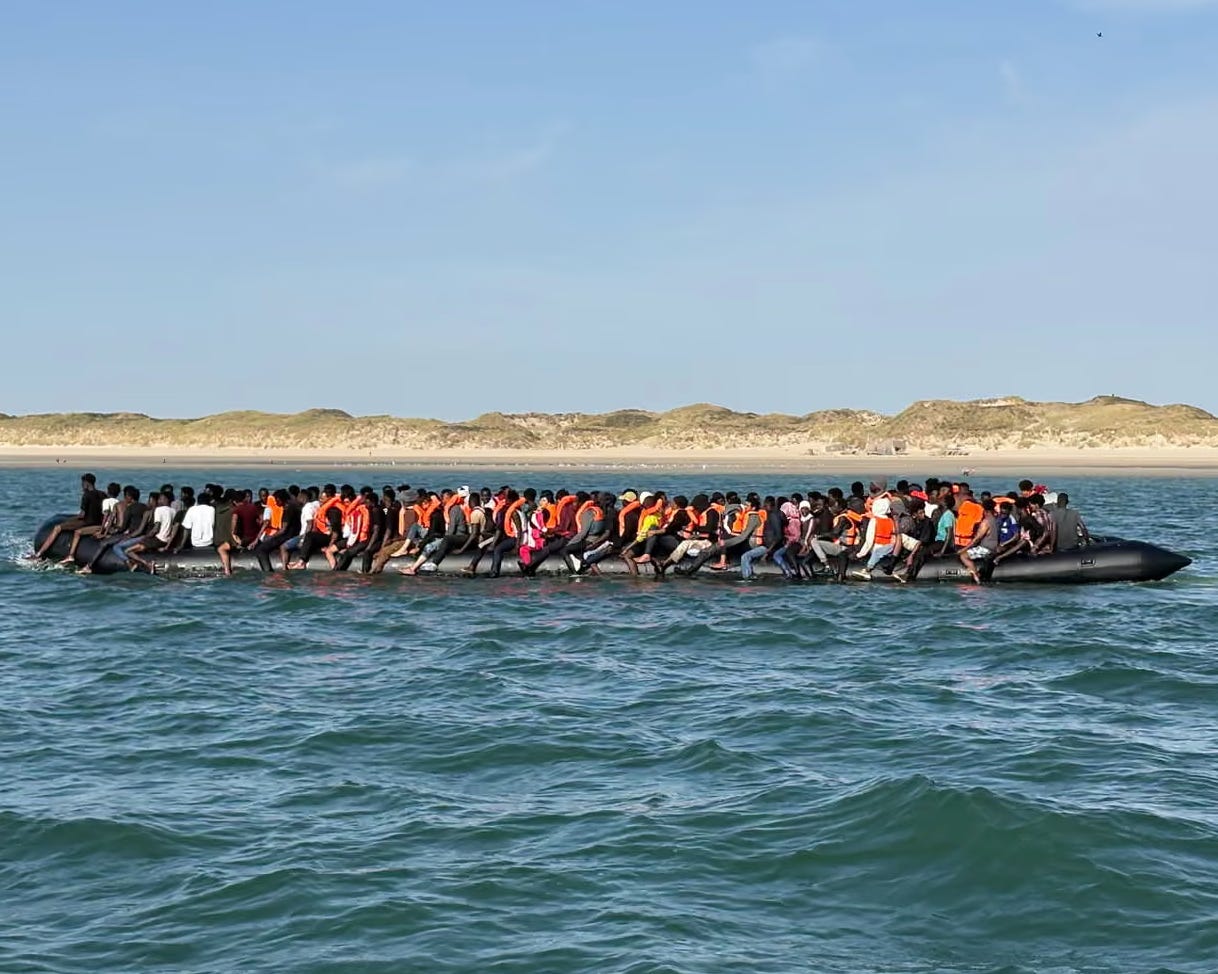
So tweeted Kay Burley in response to the latest dinghy crossing, in which a record-breaking 230 people reportedly arrived in Britain on a single inflatable boat.
I was amused by the typo, so I tweeted twice.
‘This sceptred aisle’
And:
‘“Isle” is quite the Freudian slip.’
It really is quite an interesting Freudian slip.
If ‘isle’ was a slip, then was the ‘Stop it, just stop it!’ referring to? Zia Yusuf’s tweet or the dinghy invasion itself? It is difficult to know.
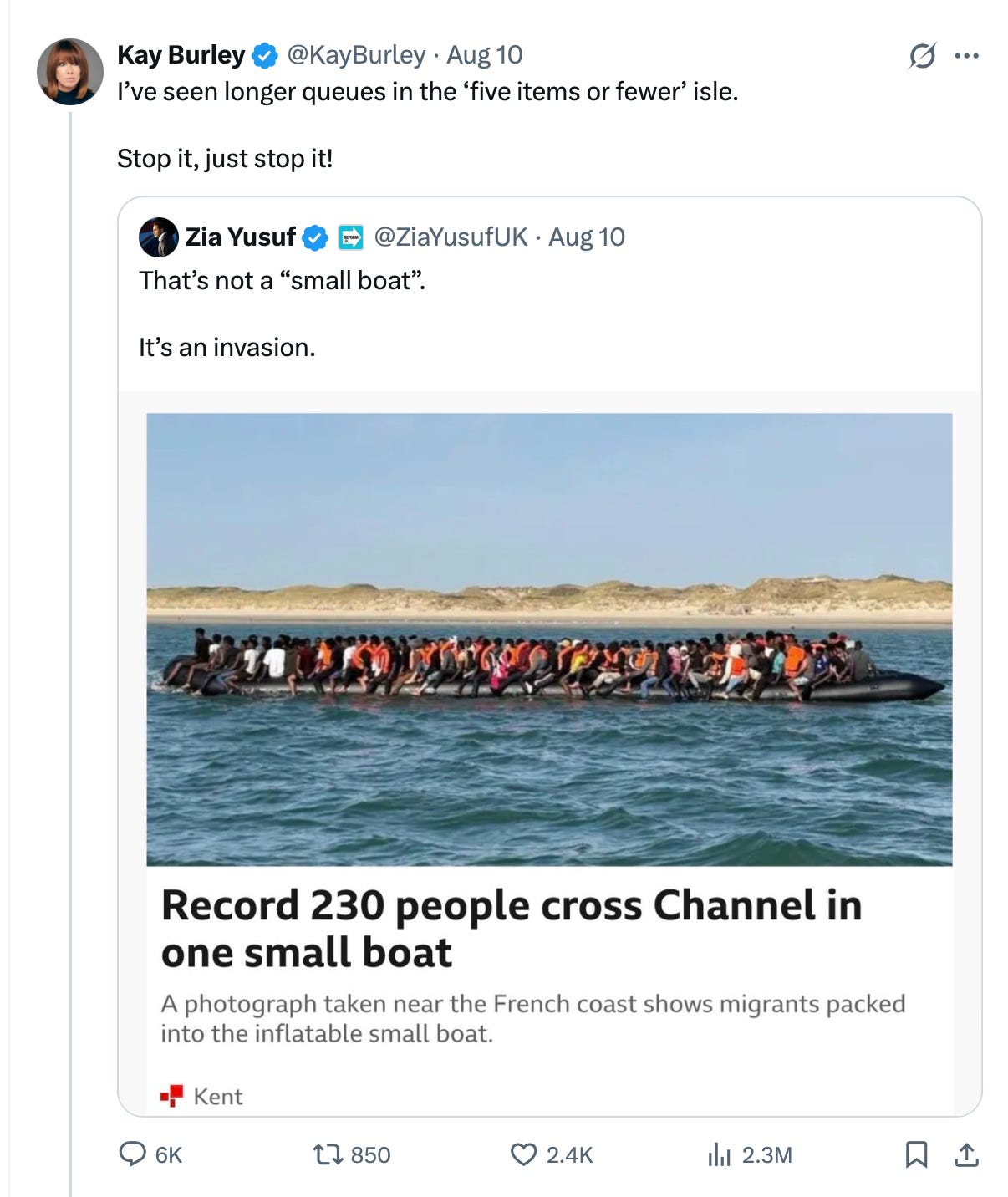
What is easier to understand is why her tweet was so widely ridiculed. Kay Burley is a high-profile journalist, probably worth millions of pounds, and seems remarkably tone deaf to the concerns of a large number of ordinary people about illegal immigration and its knock-on effects. There are concerns about housing and public services, about wages and competition at the lower end of the labour market, about crime and, increasingly, about the wave after wave of cases of rape and sexual assault we hear about.
These are legitimate things for people to be worried about. Instead, Burley wants us to ‘Stop it, just stop it!’
Back to our sceptred isle for a moment. I am sure that you, my readers, know that the term comes from John of Gaunt’s famous speech in Shakespeare’s Richard II, in which he describes England as ‘this blessed plot, this earth, this realm, this England’. He also calls it ‘a precious stone set in a silver sea’.
The England of John of Gaunt was not beset by infernos, although our own version increasingly seems to be.
The Fire Brigades Union tweeted yesterday:
‘In the last 48 hours, we’ve seen major wildfires in Nottinghamshire, Hampshire, South Wales, and Suffolk.
‘This is not bad luck. This is climate change, and firefighters are on the frontline.’
Climate change undoubtedly affects the conditions in which wildfires can start and spread. But there is a small problem with simply calling a fire ‘climate change’. Fires still need an ignition source.
As the National Emergencies Trust website puts it:
‘Increasing temperatures and changes in precipitation patterns make the UK more susceptible to wildfires.’ But ‘hotter weather alone cannot cause a wildfire. It depends on fuel, weather conditions and an ignition source, such as lightning or human action. Many wildfires are sparked by human activities, including discarded cigarettes, campfires and even arson. Unintentional acts of negligence can also have devastating consequences.’
The FBU has form on this. It has produced reports and videos over the years about climate change, positioning firefighters as the ‘first line of defence against the climate crisis’, battling wildfires and floods that it says are increasing in scale and frequency.
The expertise and knowledge of firefighters is undoubted. They know a great deal about fires. But are they experts on climate change, its effects and causes, anthropogenic or not, and the appropriate political response? Or do they, perhaps, have an interest in securing more funding for the fire service?
Elsewhere, the FBU has explained that brutal cuts have left the UK fire and rescue service stretched to the limit and ‘struggling to tackle the effects of climate change’. Its answer is, unsurprisingly, ‘urgent government funding to keep the public safe’.
Is the FBU using climate change to make a strong case for more funding?
It would hardly be the first organisation to make a persuasive case for its own resources by pointing to a new and frightening threat.
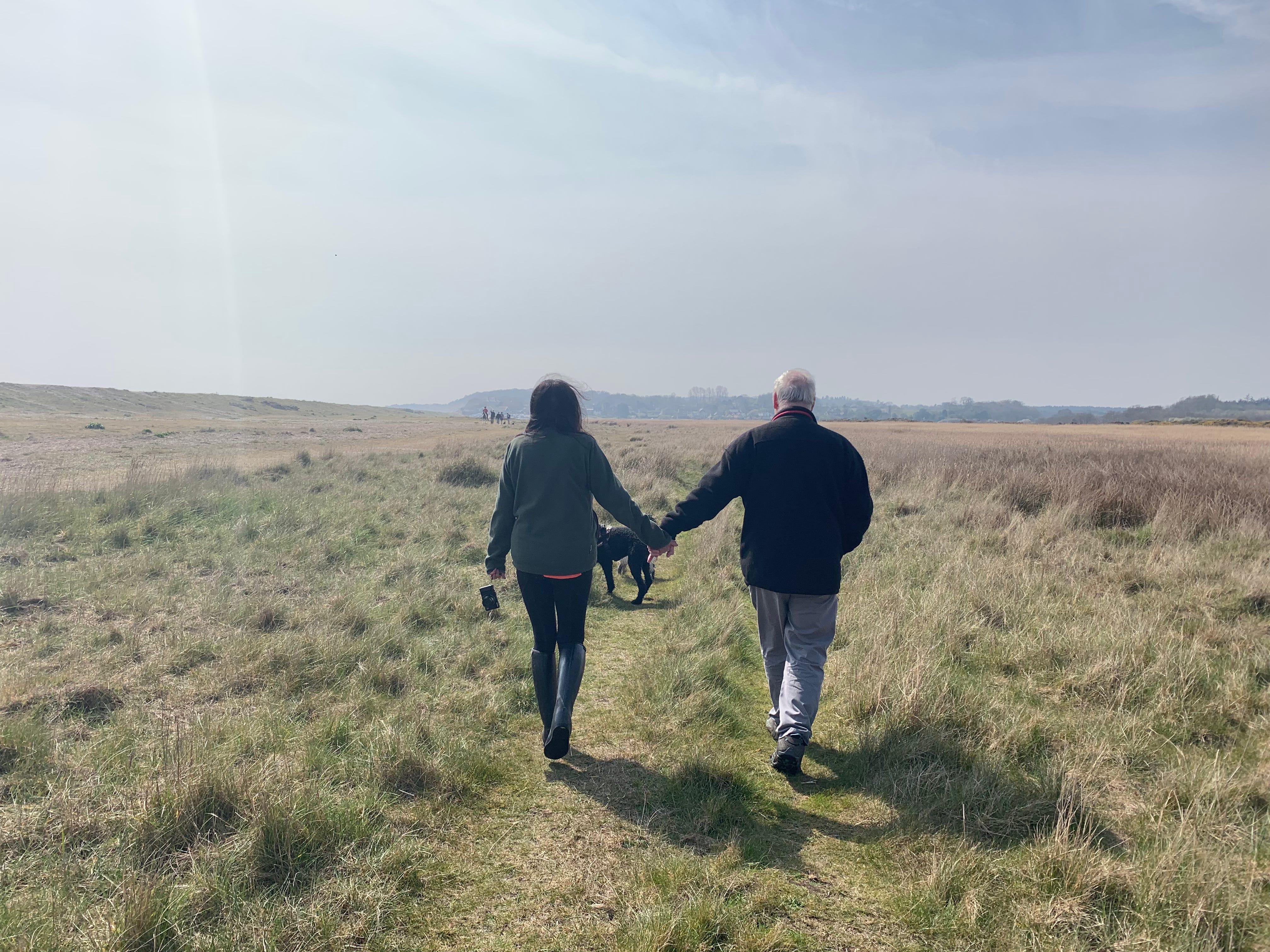
Take the recent wildfires at Dunwich, close to where my mum lives. I have walked the dogs through this lovely heath and along the beach many times. It is a beautiful, wild stretch of Suffolk, and the thought of it burning is terribly sad.
People have been quick to cite climate change as the ‘cause’. But the investigation into the cause has not concluded. And to remind ourselves, fires need ignition. That normally has a human cause. It could be cigarette butts, campfires and barbecues, fireworks, sparks from machinery, or a natural cause such as a lightning strike. It could even be deliberate arson.
As The Guardian reported, one local who did not want to give his name said the authorities needed to reinstate the larger firebreaks of old, and criticised the lack of fire paddles and fire buckets with sand that used to be stationed in forests and fire-risk areas so passers-by could quickly subdue small fires if they spotted them.
‘Now they don’t do it because of health and safety,’ he said. ‘It’s mad.’
It is an interesting detail, because while climate change is a useful explanation for why conditions might be conducive to wildfire, it doesn’t tell us what actually started the fire, nor whether practical measures that might have prevented a small fire becoming a huge one have been neglected.
If you value writing that asks awkward questions, follows an argument where it leads and occasionally says the thing everyone else seems determined not to say, consider becoming a paid subscriber to The Free Mind.
It helps keep this independent and gives you access to the rest of this piece, as well as the subscriber-only essays.
