Seven Things to be Happy About This New Year
You might have noticed that in 2025 I found myself giving in to the typical railing at the state of the nation. I would have had to be blind or mad not to. Everything felt brittle. Politics felt unreal. Institutions wobbled like a drunk on the night bus. The country felt tired, poorer and permanently lectured.
But it is not all bad news. Not even close. People are fed up of being fed up. We’re taking hope, patriotism and prosperity into our own hands. And a few sacred cows have developed a limp.
Here are seven reasons for hope in 2026.
1. When the censors get censored
One of the strangest features of the past decade has been the rise of the censorship class. NGOs, tech companies, quangos and security blobs all insisting that speech must be managed for our own good. These big brothers and nanny staters have built careers, budgets and moral status on the idea that other people could not be trusted with words — not even truthful ones.
Now comes the rather enjoyable twist. The United States has finally pulled rank and started dismantling what it calls the global censorship industrial complex. The irony is rich, as the very people who argued for silencing dissent are now discovering how it feels to be on the receiving end of administrative force. Apparently it is not so pleasant when the levers are pulled against you. File this one under poetic justice.
Marco Rubio, Secretary of State, announced:
‘The State Department is taking decisive action against five individuals who have led organised efforts to coerce American platforms to censor, demonetise and suppress American viewpoints they oppose. These radical activists and weaponised NGOs have advanced censorship crackdowns by foreign states, in each case targeting American speakers and American companies. As such, I have determined that their entry, presence or activities in the United States have potentially serious adverse foreign policy consequences for the United States.’
This includes two Britons.
The censorship industrial complex operates through subtle, insidious methods, such as visibility filtering, labelling, manipulation of search engine results, deplatforming and flagging, silencing lawful and truthful opinions on topics of national and geopolitical importance.
The US, with all its might and commitment to the First Amendment, has had enough. It’s delicious to watch and it makes the first of my reasons to be happy as 2026 commences.
2. The curious case of the ‘far right’ baptism boom
You would think the Church of England might be quietly pleased that people under forty are showing up and getting baptised, given that pews have been emptying for decades.
Instead we are treated to hand wringing about the wrong sort of Christian being baptised. Too male. Too white. Too patriotic. Too far right.
What we are actually witnessing is a hunger for roots, ritual and moral clarity in an age of flux. Perhaps when everyone else lies, ancient stories, the greatest story ever told, start to look attractive.
Even if it is reactionary, it’s remarkable to witness a revival in Christian faith. It’s a shame that the usual suspects can’t welcome new believers with open arms.
3. Red, white and blue is not a hate crime
Something quietly cheering has happened on Britain’s streets. Flags in windows, hanging from motorway bridges, flags festooning lampposts and daubed on roundabouts. Red, white and blue doing what the colours are supposed to do, lifting the mood.
Operation Raise the Colours has predictably annoyed all the usual people. Apparently it is ‘Anglocentric patriotism’, which sounds like the sort of phrase invented by someone who has never enjoyed anything spontaneously in their life and definitely does not appreciate this sceptred isle.
Most people, however, seem relieved to be allowed to indulge in a spot of patriotism again. Which raises the obvious question: how did we move from Cool Britannia in the 1990s to people flinching at the sight of their own flag? A country embarrassed by itself is not a healthy country, and so Operation Raise the Colours feels like an important correction.
4. Trump’s Christmas present to Nigeria
For years, the mass killing of Christians in Nigeria has been one of the world’s most shamefully ignored stories. Villages have been burned, churches attacked, girls abducted, thousands murdered and tens of thousands displaced.
Over Christmas, pressure from the US finally forced the issue into daylight. The killing has been named for what it is: religiously motivated violence on an industrial scale. Indeed, President Trump labelled Nigeria a ‘country of particular concern’, a designation used by the US State Department that provides for sanctions against countries ‘engaged in severe violations of religious freedom’.
And on Christmas Day, the US launched ‘powerful and deadly’ strikes against militants linked to the Islamic State group in north western Nigeria.
One report notes that tens of thousands of Christians have been slaughtered over the past decade, with entire communities wiped out while the West looked the other way. It should never have taken this long, but perhaps this is the beginning of vital recognition and decisive action to avert brutal religious persecution.
5. Net Zero is losing its halo
Net Zero has been sold as a moral absolute, immune to cost, trade offs or democratic consent. Question it and you were cast as a climate denier, a term deliberately meant to conjure ‘holocaust denier’.
But is the spell finally breaking before we are ruined? Sceptical and critical media coverage is mounting. And 52% of the public blame high energy bills and food prices for the high cost of living. Just 41% of the public say they feel confident to say they understand what Net Zero means. I would like to see Ed Miliband succinctly explain this too. Crucially, 37% say that the Government’s top priority for energy policy should be secure and reliable energy, and only 13% think that the UK should be meeting the Net Zero targets as quickly as possible.
Perhaps sky high energy bills, deindustrialisation and hollowed out towns are concentrating the minds of our political leaders and wet media class. Even the Financial Times is now hosting awkward conversations about affordability, grid capacity and the small matter of whether the public can actually pay for this stuff.
Opposition parties pledge to axe vanity Net Zero schemes, shareholders have urged BP to sell off underperforming green energy assets, the EU has abandoned the ban on petrol cars, Reform pledges to scrap Net Zero and all associated subsidies.
Net Zero may survive in some diluted and less harmful form, but the fantasy version is starting to crumble.
6. The trans juggernaut slows down
One of the most extraordinary moral panics of modern times appears to be running out of road. As human rights charity Sex Matters puts it, the law is now clear on toilets, schools, sports, freedom of belief and women’s rights.
How did it last so long? How did so many institutions abandon common sense?
If nothing else, transgender ideology will stand as a textbook case of a psychic epidemic, a lesson in the worst excesses of cognitive biases, moral bullying and the human capacity for collective self delusion.
It’s an enormous relief that not only is the law becoming clearer, the atmosphere is palpably more sensible and honest.
7. Super flu, super boring
Recent headlines have appeared to be breathlessly cranking the nation back into a state of managed fear. The Guardian warned ‘NHS facing worst case scenario as hospital flu cases jump 55% in a week’. ‘Super flu strikes during perfect storm for NHS,’ cautioned Sky News. You know the drill, you remember 2020.
And that’s the point. Many of us remember 2020 only too well.
Yes the NHS might be on its knees. It always is, because it runs permanently at low spare capacity and calls it efficiency. Annual winter pressure is not an apocalypse.
After 2020, the public is far harder to scare. Thankfully, masks and mini lockdowns have remained the fantasies of public health officials. The public’s trust, once broken, does not regenerate on demand.
None of this means everything is fine. It plainly is not. But we have to get our good news where we can. If you can see a few cracks of light, add them below. What did I miss?
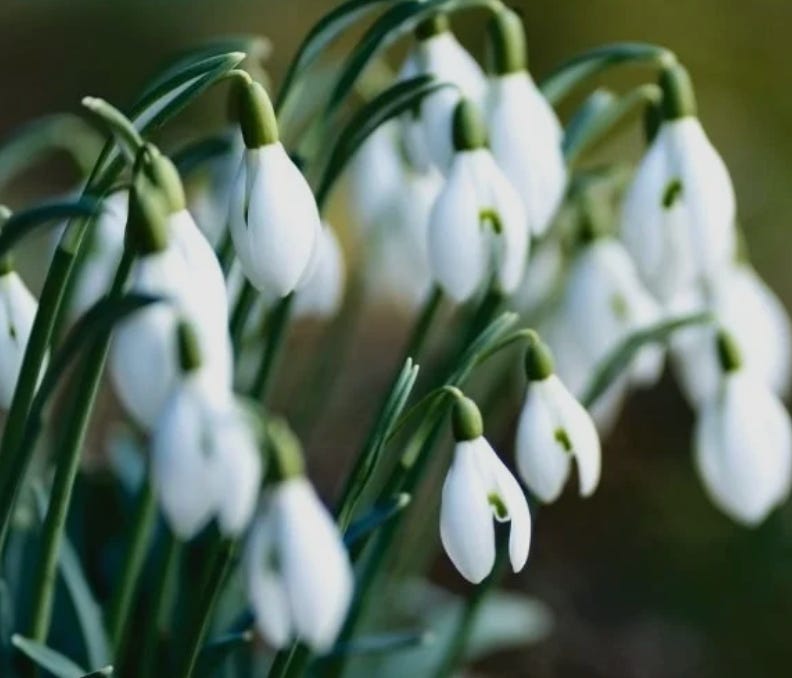
Finally, the weather was really rather lovely today. I saw snowdrops on the first day of the year. Is this mild weather a sign of climate catastrophe? If so, it was very pretty.
Happy New Year to you and yours!


One more for me was seeing tractors on Downing Street. Okay raising IHT threshold from £1m to £2.5m isn’t much, but it shows the government is on the back foot. Definitely 2026 is a year to buy direct from your nearest farm shop everything you can afford.
Great work Laura.
An 8th for me will be the total annihilation of Labour at the May elections again this year to follow last year 's.