

Part One: The Old Road
Two postcards from Brazil. The first: a window into a world that knows what it is.

In the hills of Minas Gerais we stayed on a fazenda whose owner had built his own chapel. He had constructed it from scratch, even applying the gold leaf himself. He opened its doors and showed us in with the pride of a man revealing his life’s work. He pointed out where the light switches were, including the spotlights on the Blessed Virgin Mary, and invited us to use it whenever we liked during our stay. A few days earlier, in a bar in Ouro Preto, we met a young man who had built nothing at all.
And so I have written two essays about Brazil. The distance between those two men is what this pair of essays is about.
The first is a window into an old world of Baroque churches on hilltops, mule tracks through the mountains, a country saturated in its own faith and confident in its own culture. This first essay is free.
The second was inspired by the young American man and it is a picture of something much more modern. He had a gentle voice, whimsical tattoos and chipped green nail varnish, and he gave me as much to think about as anything else in Brazil. It sits, with more about the young man, behind the paywall. Unlike him, I believe in finishing what I start and being paid for my work. Consider a subscription an act of resistance against the Peter Pan generation and a small vote for the world of finished things — more on that in the second instalment.
The road
My husband and I spent our weeks in Brazil travelling the Estrada Real, the 1,630 kilometre network of royal roads built after gold was discovered in the streams of Minas Gerais at the end of the seventeenth century. The Portuguese Crown, which presumably never met a commodity it didn’t want to tax, decreed that gold and diamonds could travel to the coast only along official routes, littered with checkpoints to ensure that all dues were collected by its taxmen. Cutting your own path through the forest was a crime. The first route, the Caminho Velho, ran from what is now Ouro Preto, down to the little port of Paraty, where the gold was loaded onto ships for Rio and then Lisbon. When the sea leg proved irresistible to pirates, a second route, the Caminho Novo, was driven directly overland to Rio de Janeiro in the early eighteenth century.
In modern times it has been reincarnated as a tourist route, signposted, mapped and walked, ridden and driven by Brazilians rediscovering their own interior. You can even stamp an Estrada Real passport as you make your way round. But it would be fair to call it ‘off the beaten track’ for international visitors. In fact, entirely due to our own fault, we ran out of road, literally, a few times and had to make hair-raising U-turns. At one point we were nearly stuck, flummoxed and sweating in front of a cliff with just a horse for company.
We travelled short stretches of the old road, longer stretches of tarmac new road alongside, and stayed in Rio, Petrópolis, Santos Dumont, Ouro Preto, Tiradentes and Paraty.
Each town is its own small history lesson. Petrópolis is the imperial city in the mountains above Rio, built as the summer refuge of Emperor Pedro II. Santos Dumont is named for the Brazilian aviation pioneer born on a fazenda nearby. Ouro Preto, the old gold capital, is a jewel of steep cobbled streets, old colonial properties and many beautiful churches. Tiradentes is named after a soldier and dentist (Tiradentes was his nickname and literally means ‘tooth puller’) who led a failed uprising against Portugal and was hanged and quartered. Don’t let that put you off, it’s a historically important and quaintly beautiful town. And Paraty, where the gold once left the country, is now a perfectly preserved colonial port of whitewashed houses and painted doorways, pizzerias and souvenir shops.
The gold that turned into churches
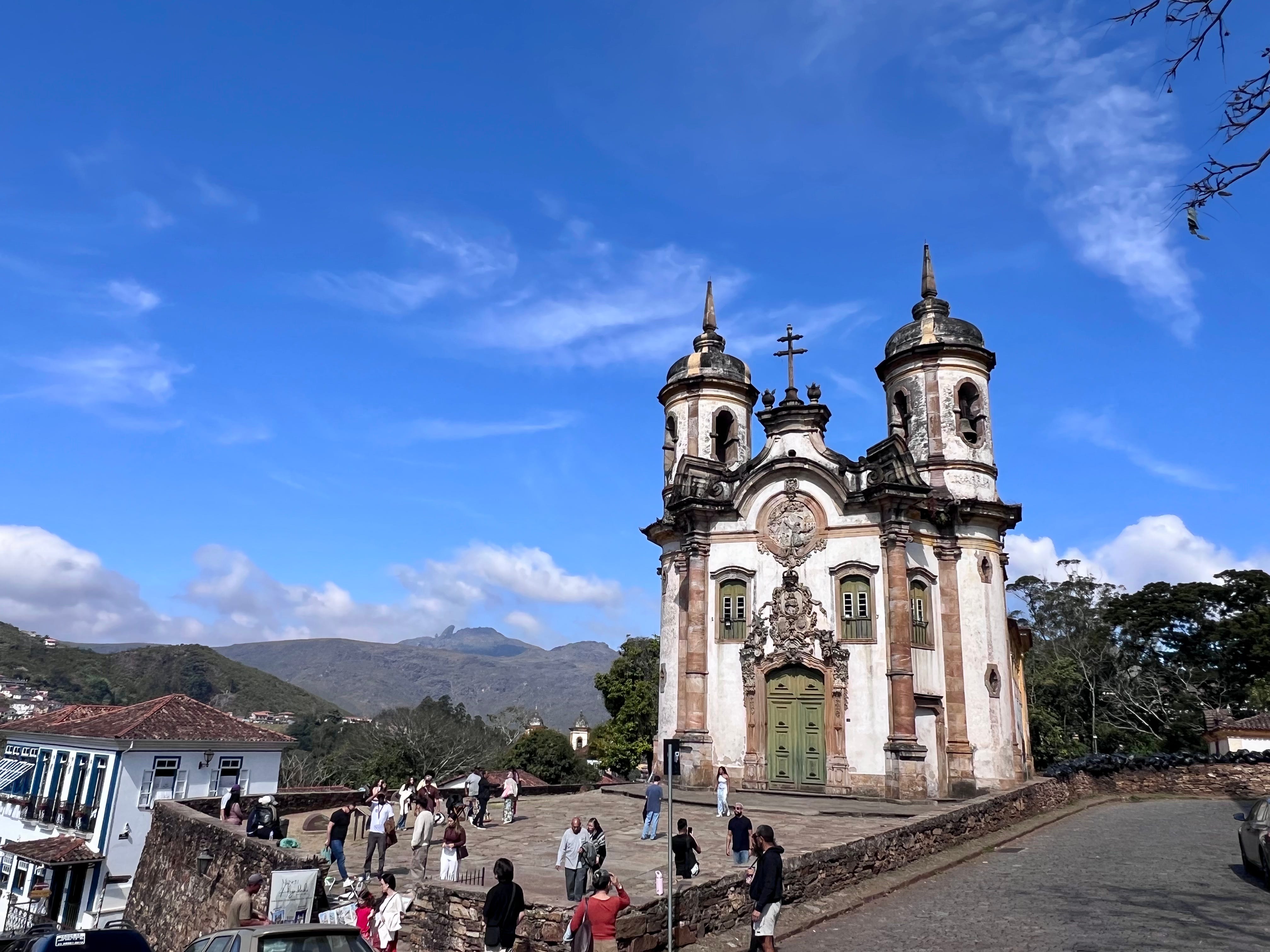
The gold rush left beautiful churches in its wake. Minas Gerais took its eighteenth-century fortune and spent a remarkable share of it on God. One church in Tiradentes sags under the weight of the interior gold.
Baroque churches stand on hilltops, punctuate the streets of towns and villages, and sit nestled in valleys, their towers visible for miles. In Ouro Preto the lay brotherhoods competed to outbuild one another, and the result is an astonishing concentration of Baroque and Rococo architecture. Some were designed and built by Aleijadinho, the mixed-race sculptor son of a Portuguese architect and an African slave, who continued to do his own carving after leprosy took his fingers, with tools strapped to his wrists.
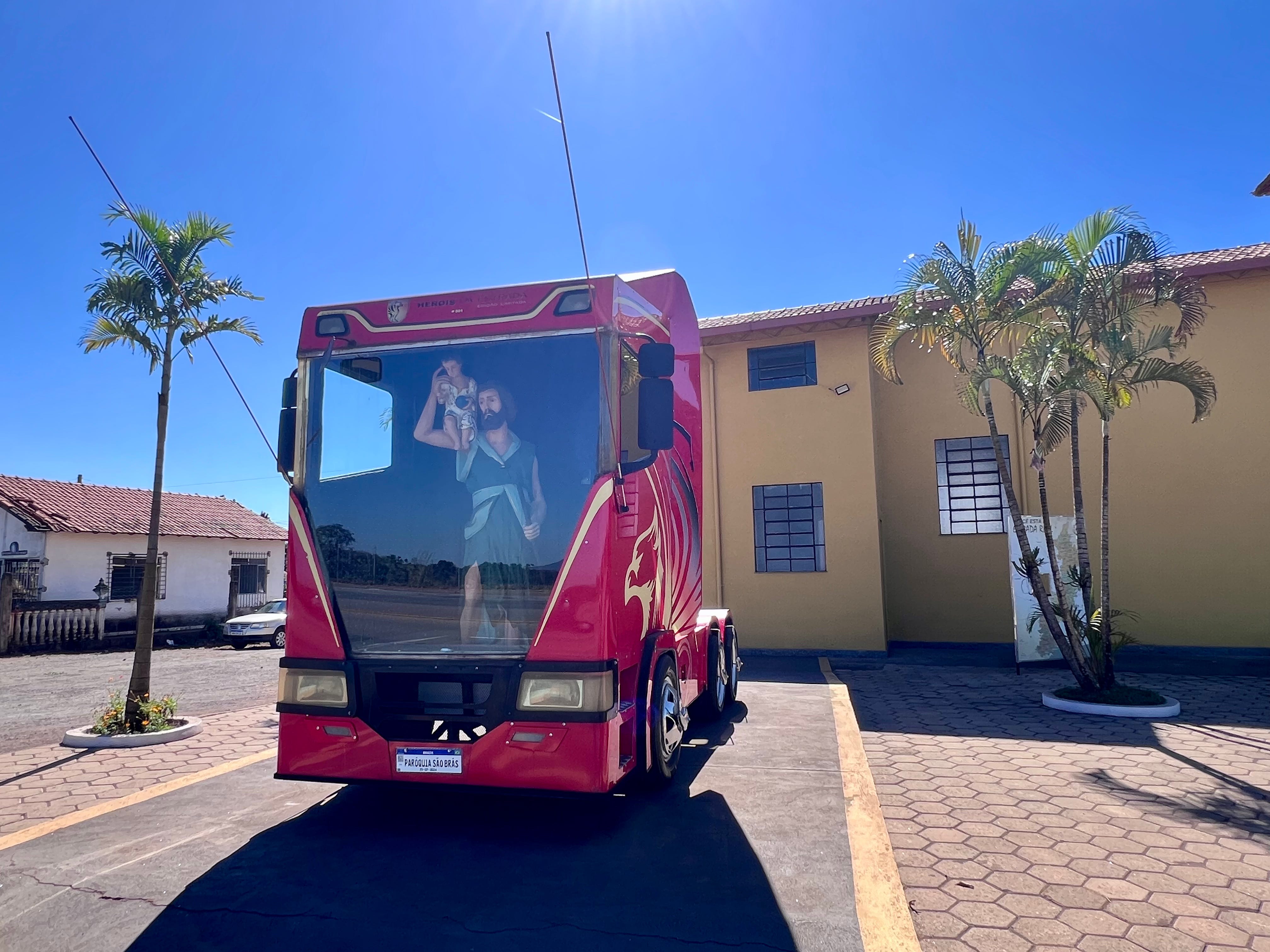
Faith is not confined to the churches. Homes have shrines in their gardens and shops keep icons by the till and in the windows. One church had a fire truck outside with a statue of St Christopher holding the baby Jesus. I can’t tell you why. We pulled over to take photographs, as you can see here.
Regular readers will know I am on my way into the Catholic Church, a road that began with an unscheduled epiphany on a hilltop in Santiago (Saint Laura and the Hilltop Epiphany). So yes, of course I loved it. But you would not need to be a catechumen to love it. It is simply too pretty and too interesting not to appreciate.
A place that knows what it is
What you feel, travelling through Minas Gerais, is the deep comfort of a religiously and culturally coherent place. Everyone is speaking the same language, worshipping (broadly) the same God, cooking recognisably the same food. I appreciate that this homogeneity may not appeal to everyone. For instance, closer to home, Sadiq Khan likes to boast that more than 300 languages are spoken in London — as if people visit our capital for the Tower of Babel rather than the Tower of London. But I prefer to holiday in a distinct culture. If I am honest, I prefer to live in one, and I suspect most of the world, which arranges itself into distinct cultures wherever it is permitted to, feels the same.
The interesting thing about Brazil that our politicians should take note of is that it is spectacularly multi-ethnic and yet not, in a meaningful sense, multicultural. The population is a mixture of Portuguese, African, Indigenous, Italian, German, Japanese, Lebanese and more. Surprisingly, São Paulo holds the largest Japanese community outside Japan and one of the largest Lebanese diasporas on earth.
But these groups did not settle into siloed ‘communities’ (as they are uncritically labelled here in the UK) with parallel languages, laws and loyalties. They became Brazilian. Some of that will have happened naturally, and some of it was policy. In the 1930s the Vargas government decided assimilation was not optional, imposing immigration quotas and launching a 'nationalisation campaign' that shut down foreign-language schools, made teaching in Portuguese compulsory, closed newspapers and dissolved ethnic associations. About 2,500 immigrant community schools were closed by the state. Perhaps this all seems heavy-handed by today’s standards, but the result three generations on is a country where a Brazilian of Japanese or Lebanese descent is simply a Brazilian.
Brazil chose one culture built from many peoples. We have chosen many cultures and, increasingly, no shared people at all. Even Keir Starmer called us an Island of Strangers.
One faith
The most apparent homogeneity is religious. Brazil is nearly entirely Christian. The 2022 census, published last year, found 56.7% of Brazilians are Catholic and a further 26.9% are Evangelical. So that’s already well over 80% Christian before you count the Spiritists (1.8%) and the roughly 1% who follow the Afro-Brazilian religions of Umbanda and Candomblé. Islam barely registers. The 2010 census counted around 35,000 Muslims in a country then of 190 million, less than 0.02%. Brazilian Muslim associations suggest much higher figures that would still not reach 1% and are contested. In all our weeks on the road I saw one hijab and not a single mosque.
In the areas I visited there were countless Catholic churches, wayside shrines and icons, one Candomblé altar, and a scattering of Baptist and Seventh-day Adventist chapels. For all the impression of Brazil as a carnival of diversity, its religious landscape is about as diverse as mediaeval Somerset.
It is not all plain sailing though. Catholicism has declined from over 90% in the 1970s and has lost ground fast to the Pentecostal churches and to no religion at all. The Evangelical surge which comes largely out of favelas and urban areas has brought its own tensions, including violent harassment of Umbanda and Candomblé worshippers and attacks on their terreiros, and that appears to be framed as partially racial and cultural in origin.
A holiday in Brazil doesn’t make me an expert on the country. Still, my impression was of a country of 200 million that overwhelmingly shares a faith, a language and a culture, forged deliberately out of extraordinary human variety.
The young man in the bar in Ouro Preto found it beautiful too, as it happens. He loved Brazil’s melting pot. He just had no idea what he was looking at, in rather the same way that he thought the Saxons were Vikings. But that, and his chipped green nails and his green-card scheme all belong to the second postcard.
Part Two is for paid subscribers. He might tell you to cheat the system. I’d politely ask you to subscribe.