Noa Argamani and choosing life.
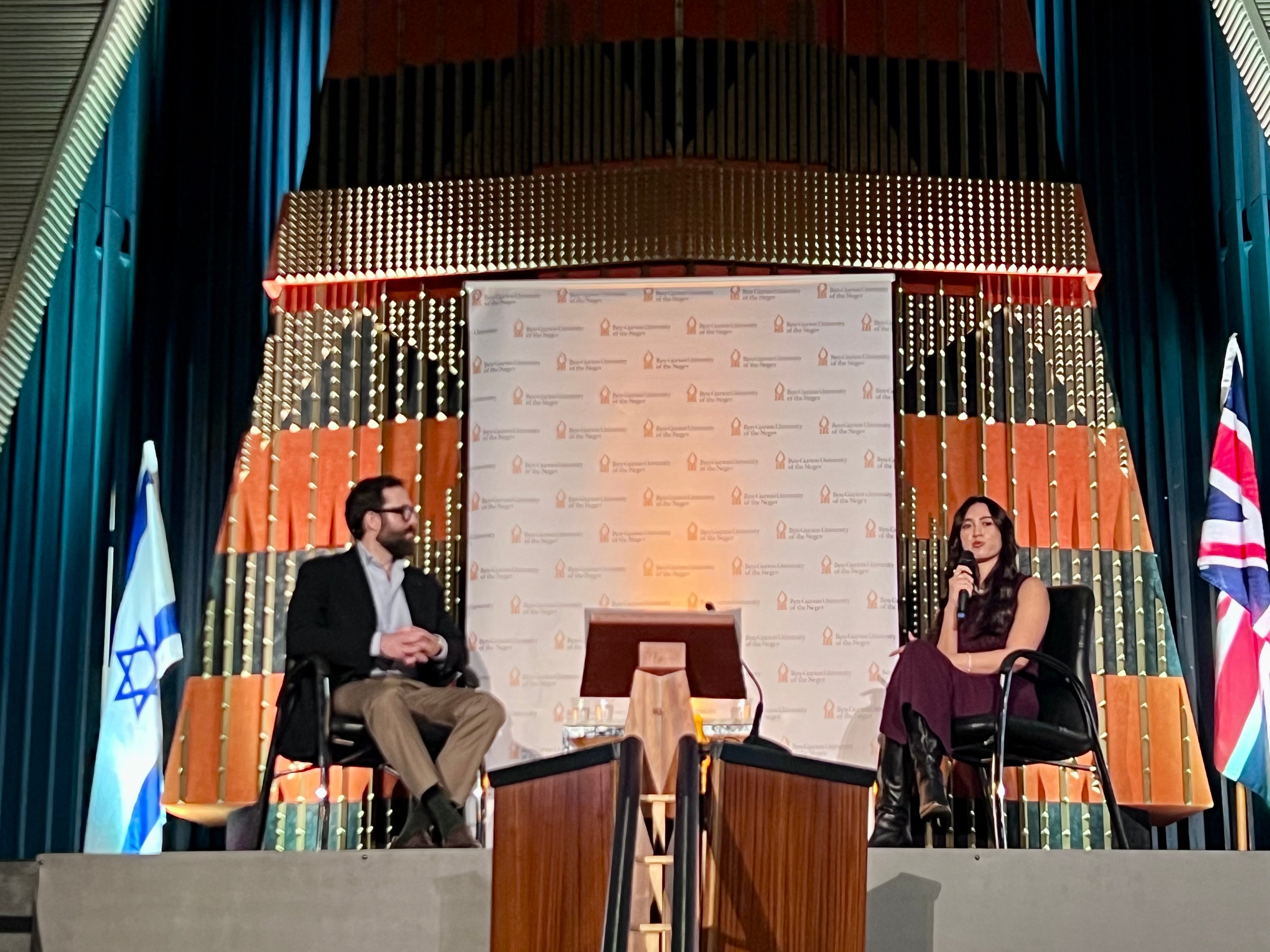
At a recent Ben Gurion University Foundation event, Noa Argamani appeared in conversation with journalist Jonathan Sacerdoti. She is slight, composed and softly spoken. If you did not know who she was, you might think she was a student talking about a gap year, not a young woman who spent 245 days as a hostage in Gaza.
But the audience knew exactly who she was. The whole world saw her on 7 October 2023, when Hamas terrorists abducted her from the Supernova music festival. She was forced onto the back of a motorbike, screaming, reaching out towards her boyfriend Avinatan Or as they were torn apart. The footage spread across the internet within hours. Her face became one of ‘the faces’ of that day.
She was rescued on 8 June 2024 in a daring Israeli special forces operation in central Gaza. When soldiers reached her, one of them said the words we heard repeated on stage: ‘Noa, everything is fine, we’re taking you home.’
She said she did not believe them at first. Only when one of the soldiers hugged her did she realise she was safe. No one had hugged her in captivity.
Her rescue came on her father’s birthday, something she described as one of the miracles in her story. Another was that she was freed in time to see her mother, who was terminally ill with cancer when she was kidnapped. They had only a few weeks together before her mother died. She said that coming back to see her mother again was everything she had prayed for, and a prayer her mother had prayed too.

What struck me most during the evening was not only what she endured, but how she made sense of it.
She described praying every day in captivity. At first she said she asked for nothing, only telling herself to be grateful for what she had — a T-shirt, a blanket, socks, a little water. When you have nothing, she said, you learn to be thankful for everything.
Later she began to ask God for things. She told the audience that she noticed something strange. If she prayed for water, the next day the terrorists might bring water. Once she prayed for water and was given drinking water, but what she really wanted was water to wash, so she learned to be specific. She laughed slightly when she said it, but she did not sound as if she thought it was a joke.
She never declared exactly what she believes religiously — mother was Chinese and her father is Israeli —but she spoke openly about faith, about prayer, and about the way captivity forced her to live moment by moment. She practised and developed mindfulness because she had no choice. You cannot live every second in fear, she said. Sometimes you have to tell yourself: right now I am alive, right now I am OK.
The horrors she described were almost impossible to take in. She spoke about weeks without showers, about ‘starving’, not knowing if she would have food from one day to the next, hearing gunshots, and constant uncertainty. She looked after two young girls who were still in the Disney pyjamas they’d been wearing when they were kidnapped from their homes. She spoke about seeing another hostage executed in front of her. She spoke about another hostage dying beside her in the rubble after an air strike. Listening to her, in a safe, comfortable Synagogue in North London, it did not feel real. Perhaps the mind protects itself by refusing to fully absorb what it hears.
She said she had to ‘play the game’, appeasing the terrorists any way necessary, including pretending to believe their fake names, because she thought that if they realised she had heard their real names they might kill her. One detail of how ‘horrific’ appeasing the terrorists was stayed with me. At one point she suffered a head injury during an air strike and forced herself to stay awake all night because she remembered being told as a child not to sleep after hitting your head. The terrorist guarding her became angry and asked why she did not trust him. She could not explain in her basic Arabic that she was trying to stay alive. Imagine the gall of being asked by an angry violent, terrorist holding you captive why you do not trust him.
At one point she said something that helped make sense of both her impressive attitude and the survival of her resilient nation.
She noticed that the men holding her prayed for death, while she prayed for life. That realisation frightened her, but it also changed her. If they wanted death and she wanted life, then she decided she would choose life every day, even there.
It is an extraordinary thing to hear someone say that they learned mindfulness from death-loving jihadists.
After her rescue she could have disappeared from public view. Instead she said she felt she had a mission. Within weeks — shortly after her mother died — she travelled abroad with Israeli leaders to campaign for the release of the remaining hostages, including Avinatan, who was still in captivity at the time. She has spoken to politicians, the media and the public around the world, determined that the story should not fade.
At the end of the evening something happened that would be almost unimaginable at a British talk. The audience stood and spontaneously began to sing Hatikvah, the Israeli national anthem, voices joining one by one.
It struck me that Israel produced Noa Argamani, and that the Jewish people — in Israel and in the diaspora — seem to understand something many of us have forgotten. They sing in grief, they sing in joy, they sing in defiance, and they sing because they are still alive.
Perhaps we could all do with being a little more Zionist.


What emerged from the hostages that survived is that not one Palestinian, even women in the houses that hostages were moved between, showed any humanity or decency toward the captives. In the tunnels where some hostages were kept by Hamas fighters things were inhuman, but that civilians also treated hostages without the slightest compassion or human feeling is telling.
This moves me deeply. Gently powerful, beautiful Noa - and her story.. of a journey into resilient strength, a deep love of life and of Israel 💙🇮🇱