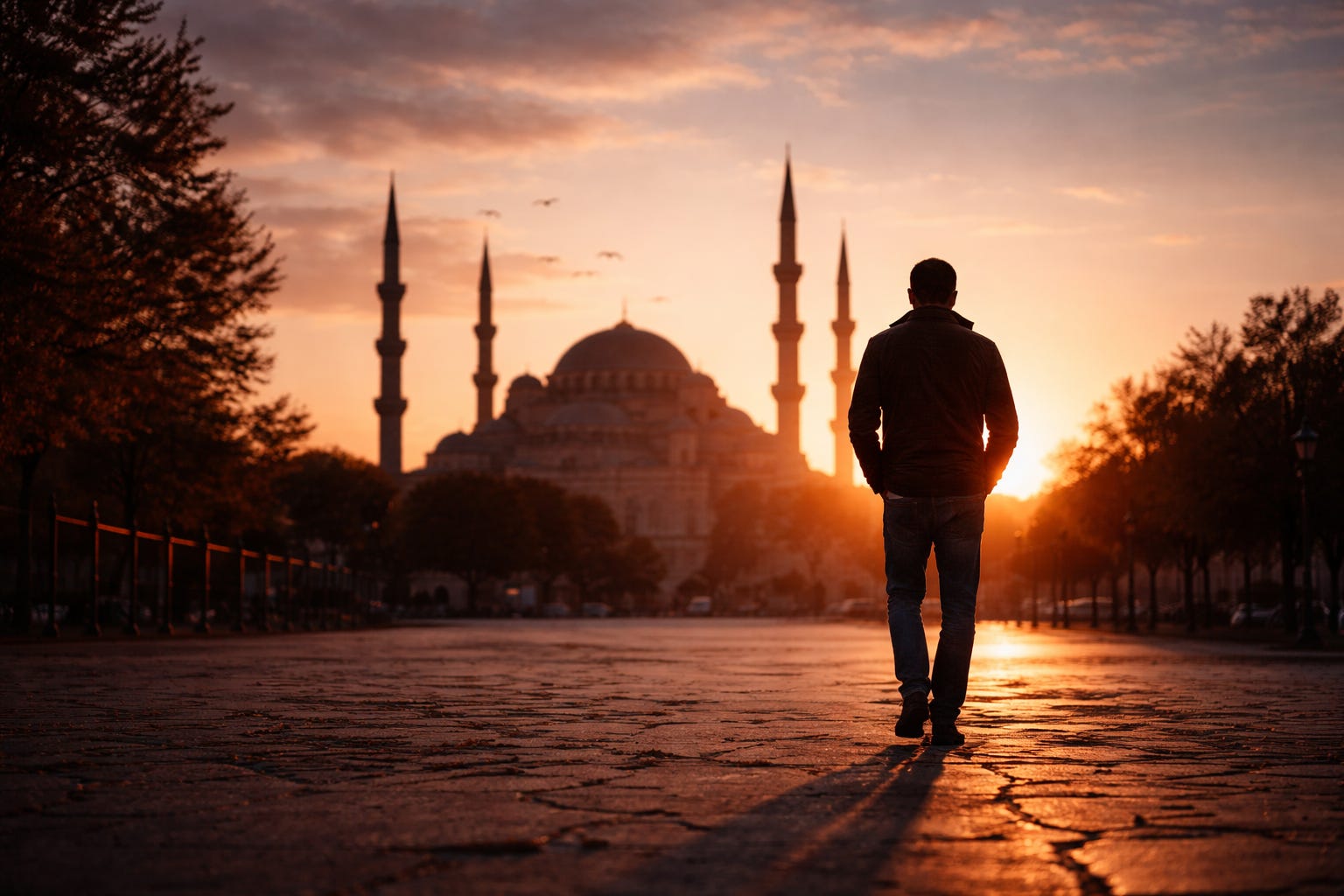
Ex-Muslims will be the conscience of the Islamophobia debate, just as detransitioners were to trans ideology.
The most powerful challenges to ideological systems often come from the people who have lived inside them — and left.
In Britain, the government has recently adopted a non‑statutory definition of ‘anti‑Muslim hostility’ intended to address hostility directed at Muslims, while supposedly remaining compatible with freedom of expression.
The full definition reads:
‘Anti‑Muslim hostility is intentionally engaging in, assisting or encouraging criminal acts – including acts of violence, vandalism, harassment, or intimidation, whether physical, verbal, written or electronically communicated – that are directed at Muslims because of their religion or at those who are perceived to be Muslim, including where that perception is based on assumptions about ethnicity, race or appearance.
It is also the prejudicial stereotyping of Muslims, or people perceived to be Muslim including because of their ethnic or racial backgrounds or their appearance, and treating them as a collective group defined by fixed and negative characteristics, with the intention of encouraging hatred against them, irrespective of their actual opinions, beliefs or actions as individuals.
It is engaging in unlawful discrimination where the relevant conduct – including the creation or use of practices and biases within institutions – is intended to disadvantage Muslims in public and economic life.’
In practice, the new definition opens the door to several serious issues. Here are five.
The first is free speech. Broad definitions of ‘Islamophobia’ or ‘anti-Muslim hostility’ risk becoming de facto blasphemy rules. Criticism of Islamic beliefs, practices, or institutions can easily be interpreted as hostility toward Muslims, which has the potential to chill and narrow public debate. The government report claims that criticism, ridicule and concerns remain permissible, but how will this really play out on mainstream media and in politics? Many journalists, academics and politicians already avoid contentious subjects rather than risk being labelled as bigots. How will Ofcom navigate anti-Muslim hostility? Codifying speech constraints through policy rather than law creates the same restrictions through the back door — and you have to wonder, is that the point?
These suspicions are only compounded by the sleight of hand substitution of the phrase ‘anti- Muslim hostility’ for ‘Islamophobia’. (There are some serious concerns about the impartiality of the Government’s Working Group on Islamophobia and even Islamist links.)
Second, the legal case is redundant. Violence, harassment, discrimination, and incitement to religious hatred are already criminal offences under the Equality Act and Public Order legislation. Creating a new definition specifically centred on Muslims just creates confusion over what is legitimate criticism versus unlawful hostility.
The third problem is the impact on equality. Why should one religion be singled out for particular protection? Should there be special definitions of hostility for all religions, and if not, why not?
Fourth, religions are belief systems and like political ideologies they must remain open to robust criticism. Liberal societies should protect individuals from harm, not ideas.
Fifth and finally, there is a conceptual difficulty embedded in separating Islamism from Islam. The idea is that criticism should be directed only at ‘Islamism’, not Islam or Muslims themselves. Islamist extremism is a serious cultural, political and violent threat in many parts of the world, including here in the UK. It is promoted and enacted by Muslims. To state the obvious, Islamism is a political ideology derived from Islam. Of course, the overwhelming majority of Muslims are not Islamists, but insisting that Islamism and Islam are entirely separate phenomena is an artificial construct.
The grooming gangs scandal illustrates the difficulty. Were the perpetrators ‘Islamists’, or were they Muslims whose behaviour was shaped in part by cultural and religious attitudes toward non-Muslim girls? Public discussion and prosecution of those crimes was suppressed for years partly because authorities feared accusations of racism, or anti-Muslim hostility. Erring on the side of silence was catastrophic for thousands of girls, their families and communities.
And yet, a group of people have the potential to be very disruptive to this new guidance — apostates.
Ex-Muslims occupy a curious position in Western debates about Islam. They know the religion intimately and while some keep a very low profile, others are prepared at great personal risk to be critical, and yet they are often the least visible voices in public discussion. They have often faced coercion, misogyny and violence first hand. Are they now more or less likely to be platformed?
As Yasmine Mohammed, author of Unveiled: How the West Empowers Radical Muslims wrote:
“Blasphemy laws in Islamic countries force people there to stay quiet. If we also choose to be quite because of self-imposed blasphemy laws, who will be left to speak? It is our responsibility and our duty and our privilege to speak our minds. People have died so that you and I can have the right to free speech. what a dishonour to their memory if we squander this gift they have given us.”
Apostates cannot easily be dismissed as outsiders motivated by bigotry or hatred. They are insiders who walked away — often at considerable risk. They occupy a role strikingly similar to another group that has disrupted a powerful contemporary ideology: detransitioners.
I did not set out to explore the contradictions of transgender ideology when I began my Bare Reality projects — photographing and interviewing people about their bodies — my aim was to explore the realities of sexed embodied life. The projects Bare Reality, Manhood and Womanhood involved hundreds of conversations about the lived experience of being male or female. Through that work I became increasingly aware of how profoundly sex shapes experience — physically, socially and psychologically.
And through that work I encountered detransitioners. These were people who had once believed that medical transition would resolve their distress, only to discover that the reality was far more complicated. Their stories — of regret, medical harm, ideological pressure and ultimately very serious trauma — were largely absent from the public narrative surrounding gender medicine. The problem is, once you hear those stories, it becomes difficult to un-hear them.
Detransitioners changed the public debate because they brought first-hand testimony. In a 2020 feature I created for The Sunday Times, they disrupted a moral narrative that had been presented as simple and unquestionable. Their existence made it impossible to maintain the claim that transition was always compassionate and benign. In short, they punctured the narrative.
Something similar is likely to happen in debates about Islam. Do ex-Muslims hold the right to express anti-Muslim hostility? Should a government protect ideas more carefully than the people who have walked away from those ideas?
Apostates speak from lived experience inside the belief system, and it is their voices which have the power to puncture anti-muslim hostility guidelines. Ironically, for people who have abandoned their faith and culture, they will be the conscience of the future conversation.


Wonderful , forensic analysis Laura.
"The same rules don't apply to us " will sow division on steroids. This government and its appeasing agenda is dead in the water. Reform cannot come soon enough !
Further to my comment (below), of course, it's absolutely deliberate that "new law" is always convoluted, iterated, nuanced and utterly impossible to make instant sense of. That way, we are all forced to keep our mouths shut, for fear of brushing against a trip wire. Keir Starmer to Donald Tump: "We have a long tradition of free speech in this country..." Yeah. Right. Did have.