

Car Graveyards and the Road to Life
A postcard from Israel, Part One.

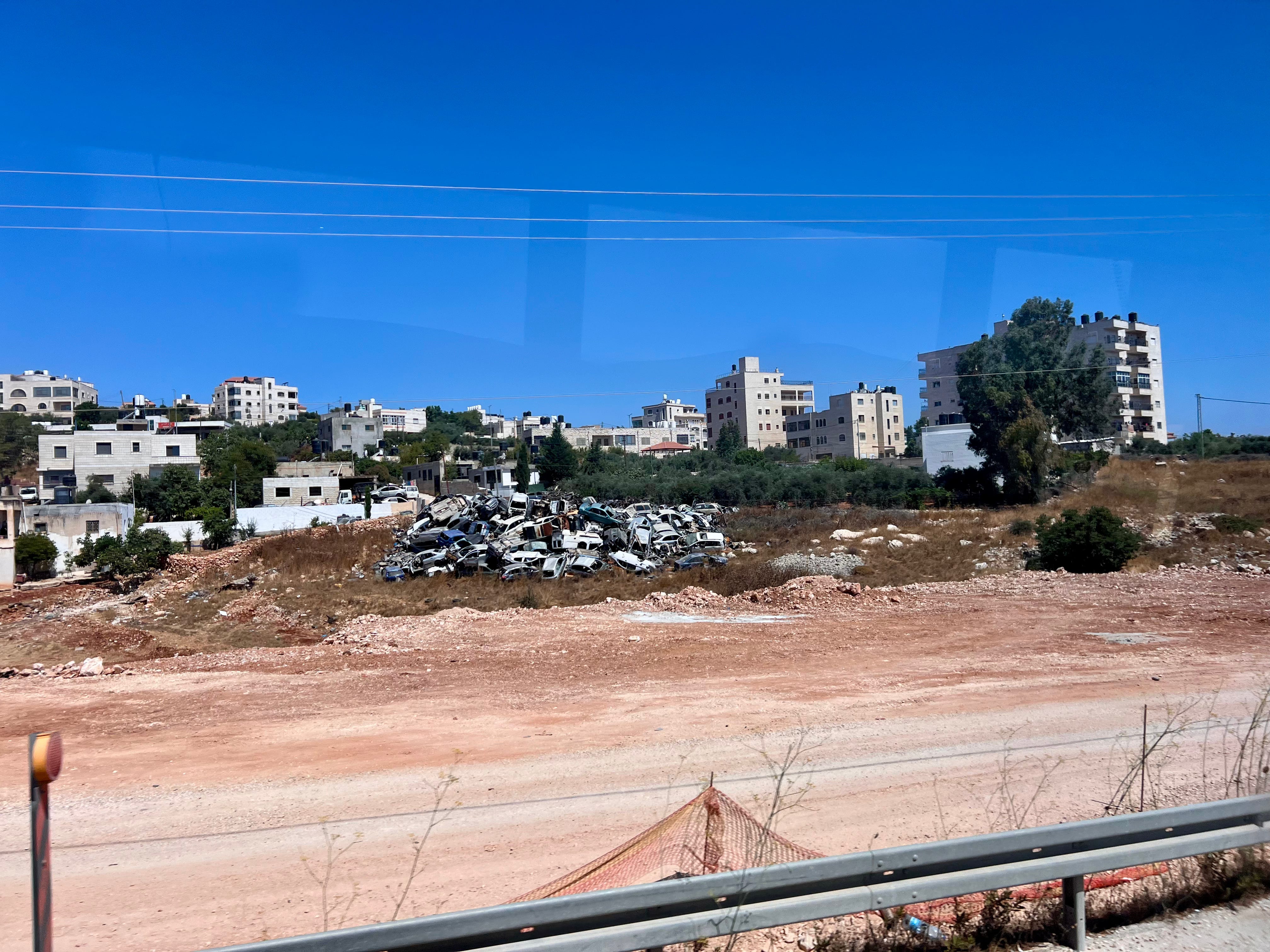
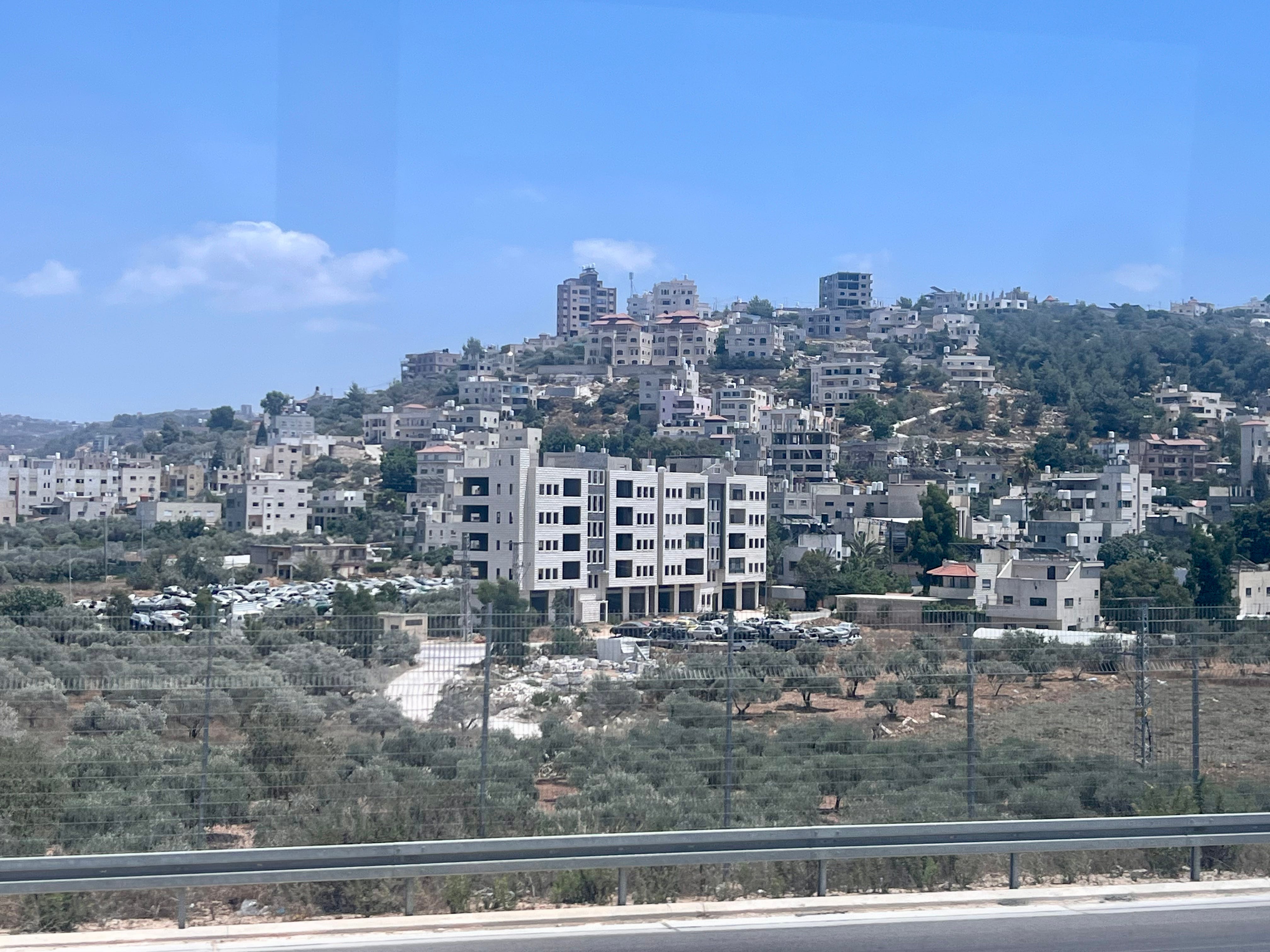
I looked through the windows of our bullet-proof bus to take my first glimpses of the West Bank.
To start with, there was little to distinguish the Palestinian Authority from the rest of Israel. Firstly, there were no bullets. The road was the same, the scenery was the same, life appeared to continue as normal. And then, there were differences.
The West Bank is the territory between Israel and Jordan, captured by Israel from Jordan in the Six-Day War of 1967 and administered since the Oslo Accords in a patchwork of zones: Area A under full Palestinian Authority control, Area B under joint arrangements, Area C under Israeli control. Palestinians and most of the international community call it occupied territory. Many Israelis call it Judea and Samaria, the biblical names for the hill country where much of the Hebrew Bible actually happened, and point out that Jews lived there continuously until the Jordanian army expelled them in 1948. Both names are doing political work. I’m going to use “West Bank” here because it is the better known term, not because I can adjudicate the competing claims. (What I can tell you is that the media noise about settler violence is a simplistic propaganda. On the ground it is much more complicated and I’ll follow up in another Substack.)
On the Foreign, Commonwealth and Development Office website the West Bank is currently shaded in a combination of safe green, dangerous red and ideally avoided orange. As a British citizen, my government would advise me to travel to the West Bank only for essential purposes. I decided that understanding this country of contradictions was essential, as part of a medical freedom-themed tour I’d been invited on by the producer and writer Karys Rhea and the organisation Combat Antisemitism Movement. We were going to visit Shiloh, the ancient capital of Israel where the Tabernacle stood for centuries before there was a Temple in Jerusalem, and two farms.
One thing which had pleasantly surprised me in Israel is how nicely everything is done. Town planning is eminently sensible and aesthetics are not an afterthought. There are more trees, manicured grass verges and blooming plants than you would expect in a desert country. The first and most visible change as we drove into the West Bank was rubbish — a great deal more of it, in fact, strewn along the roadsides.
The second change I noticed in the West Bank was car graveyards.
We drove past lot after lot of abandoned and beaten-up old cars. I asked our guide why there were so many. He offered a few reasons. First, Palestinians might buy old cars cheaply to do them up, then drive them illegally or sell them for parts. Second, they steal them. Then they may keep them, sell them on, or break them up and sell the parts back to Israelis, who unknowingly buy back pieces of their neighbours’ stolen cars.
This is not a cottage industry, which explains why the territory is littered with car graveyards. Car theft in Israel is a crime epidemic worth billions of shekels. Between 2020 and 2023, nearly 20,000 vehicles were stolen every year. According to JNS, reporting in 2023, 95% of cars stolen in Israel end up in the Palestinian Authority.
Who is behind it? According to an investigation in Haaretz, many thefts are committed by poor Palestinian teenage boys, some maybe as young as thirteen, groomed by older men and organised gangs. They are recruited on social media. One advertisement on TikTok read: “Wanted: Skilled drivers. Nine minutes of driving – 3,200 shekels in your bank account. We’ll take you there; the work is safe.” In the background of the video, an SUV descends a steep slope, captioned: “Get up and do something instead of just sitting around.” A phone number is provided.
Some boys make it, as I could see from the wrecks by the road. But some are caught at checkpoints. In 2025, 478 minors were arrested. You can feel some sympathy for kids who have been misled, who dropped out of school, whose families are poor, and who now face the full force of Israeli law. Groomed, used and abandoned by the men who hired them, they are victims too. But it was still a choice. And they would be well over the age of criminal responsibility in the UK.
The car graveyards punctuated the road, sitting in front of towns which displayed extreme wealth alongside poverty. There were palatial houses with gardens and pools. There is serious money in the Palestinian Authority. But there were also scruffy shacks, and lots of half-built blocks of flats seemingly abandoned mid-construction, windows gaping emptily, floor after floor with no one home. The number of buildings does not appear to match the number of people.
We speculated on the bus, but I didn’t get to the bottom of this conundrum then and I still haven’t. Unfinished buildings can attract lighter tax treatment. Whether foreign aid has also been parked in structures is a question I heard raised more than once in Israel, and given the documented history of misdirected donor funds in the Palestinian territories it is a valid question, but I could not verify it and I won’t pretend I did. There could be even more sinister explanations. What I can tell you is what I saw: empty buildings, everywhere.
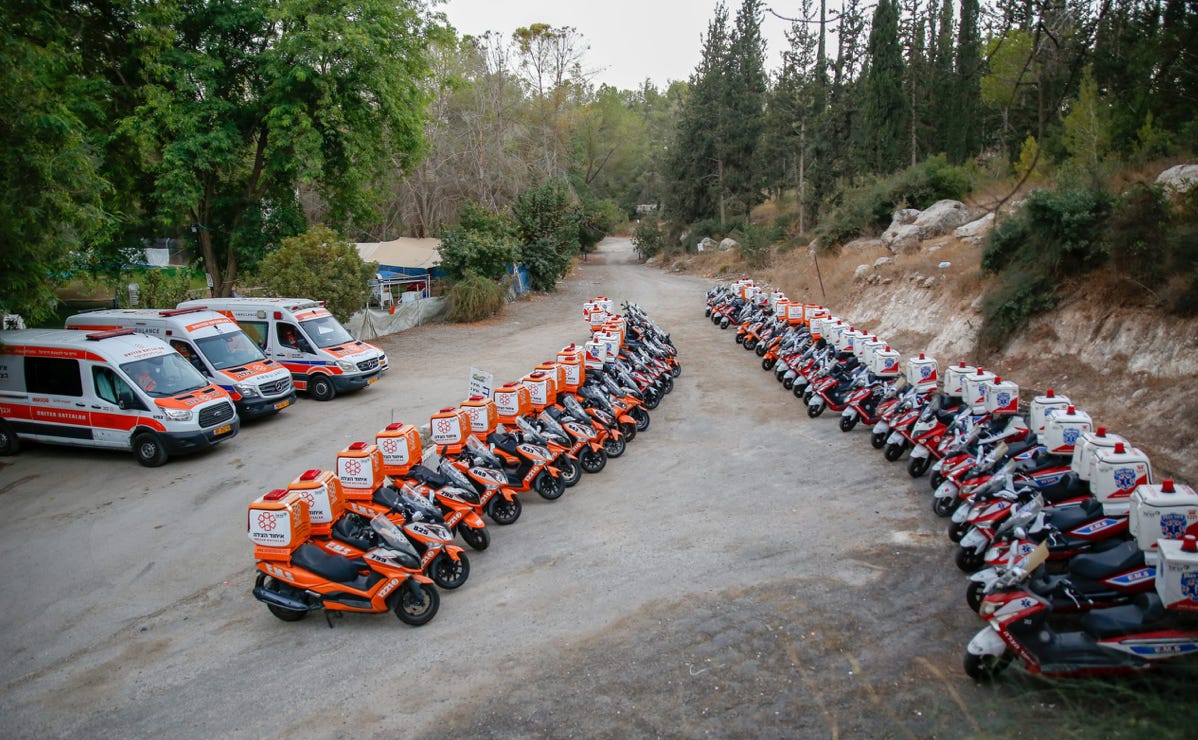
The next day, on another jam-packed tour, we visited the headquarters of United Hatzalah, with its fleet of bright orange ambucycles and ambulances.
Hatzalah means “rescue” in Hebrew. The organisation is the creation of Eli Beer, and his story is inspiring. As a small boy walking home from school in Jerusalem with his brother, he witnessed a bus bombing. A wounded man called out to him for help, and Eli, frightened, didn’t have the age, experience or knowledge to help. He has said the memory never left him and he knew from that day that he wanted to be the person who would be able to help.
He trained as a volunteer Emergency Medical Technician (EMT) and joined an ambulance crew, where he discovered for himself the dangerous delays in emergency response in a country of narrow roads and busy traffic. On one call, his ambulance took more than twenty minutes to reach a seven-year-old boy who was choking. The boy died. A doctor lived on the same street and had anyone thought to knock on his door, he could have come and saved the boy.
Eli’s answer was to develop a network of volunteers to save people’s lives, faster. In 2006 this became United Hatzalah.
Today United Hatzalah has more than 8,000 volunteers: EMTs, paramedics, nurses and doctors, secular and religious, Jewish, Muslim, Druze and Christian, in every city and town in Israel. When a call comes in, GPS dispatch technology identifies the nearest trained volunteers and sends them. These generous volunteers will abandon their working day, their sleep, or whatever they are doing to go and help.
Around a thousand ride ambucycles, which are motorcycles kitted out like mini ambulances minus the stretcher. This innovative vehicle can weave through traffic that would slow down an ambulance. There are also ambucars, e-bikes, ambuboats, a drone unit, and now a pilot fleet of electric ambuscooters. (Having always thought of e-scooters are perilously dangerous I am being forced to revise my opinion!)
The average national response time is under three minutes and in the cities it is around ninety seconds, which is the organisation’s target for the whole country. Ninety seconds.
This organisation is unparalleled in the world — thousands of ordinary people who have agreed to drop everything for a stranger. Only a high-trust society with a big heart could do it.
And tragically they must sometimes do this in bullet-proof vests. According to the Jerusalem Post, 1,700 Hatzalah volunteers went into the thick of danger on October 7, many on their bright orange motorcycles, towards the gunfire. Would you find that number of volunteers willing to risk their lives in Britain? In the United States? Anywhere? It is hard to imagine you would. Hatzalah has now ramped up supplies and has 5,000 bullet proof vests to protect their volunteers.
We were told that the core value of Hatzalah is this line, from the Talmud: “Whoever saves a single life is considered to have saved an entire world.” If the Jews are “stiff-necked”, they are no less huge-hearted.
When I think about the whirlwind of a trip to Israel these two motifs swirl in my mind’s eye: an orange ambucycle ridden by a volunteer, racing against a 90 second clock, and a car stolen GTA-style by a teenage thief, trying to evade the checkpoint.
It brings home a bitter irony. Israel stands accused in the world’s courts and media of genocide. Yet everything I saw testified to a country relentlessly, almost compulsively, committed to life. Start with the most basic measure there is. Israel’s fertility rate is around 2.9 children per woman, the highest in the OECD by a country mile. Whatever else you say about Israelis, they are voting for the future with their wombs.
Then there are the institutions. Save a Child’s Heart, based at the Wolfson Medical Center near Tel Aviv, has brought more than 8,000 children with heart defects to Israel for surgery from some 75 countries, from Ethiopia to Iraq to Zanzibar, as well as Palestinian children from the West Bank and Gaza. Israeli surgeons volunteer their time to mend Palestinian hearts. A country conducting a genocide would be an odd place to run a production line of mended enemy hearts.
Even Yahya Sinwar, the mastermind of Hamas’s barbarism on October 7, owed his life to Israeli medicine. In 2004, while serving four life sentences in an Israeli prison for murder, Sinwar underwent life-saving surgery to remove brain tumour. Get your head around that. The state accused of genocide performed hours of brain surgery to save the man who would go on to mastermind the largest slaughter of Jews since the Holocaust, because he was a patient, and that is what you do for patients.
If I seem to be leaning heavily on motifs, I should say that Israel is a land rich in symbol. You might deduce that I was simply inclined to see and decode patterns, but I am not the first person to find Jerusalem to be a “thin space”, as the Celts term a place where the veil between the physical and spiritual worlds feels porous and otherworldly. I have felt it in ancient groves of yew trees thousands of years old, I have felt it in small womb-like chapels and beneath the towering Gothic spires of Europe, and I felt it in the streets and on the hillsides of Israel. In a thin space, things do mean more than themselves.
There is more to be said. Much as with my recent essays from Brazil, I can’t claim to know the depth of a country’s soul from a single visit, but Israel made powerful impressions on me and there is a great deal to process. It met some expectations and confounded others. It is a country of paradox and contradiction: ancient and startlingly new, accused of death and teeming with life.
It is a hot, bright country and I am still squinting a little from the sun. When my eyes have adjusted, now that I am back in my own green land, I will cogitate and process and write more. For now I will leave you with this. A car graveyard is not just a scrapyard, and an ambucycle is not just a motorbike. They are two answers to the same question — what do you do with the life you are given, and with the lives around you?
Fascinating and enlightening essay Laura.
Very interesting, thank you.